

11th Global Pharmaceutical Quality Summit 2026
Reimagining Pharma Operations
Talent, Technology and Trust
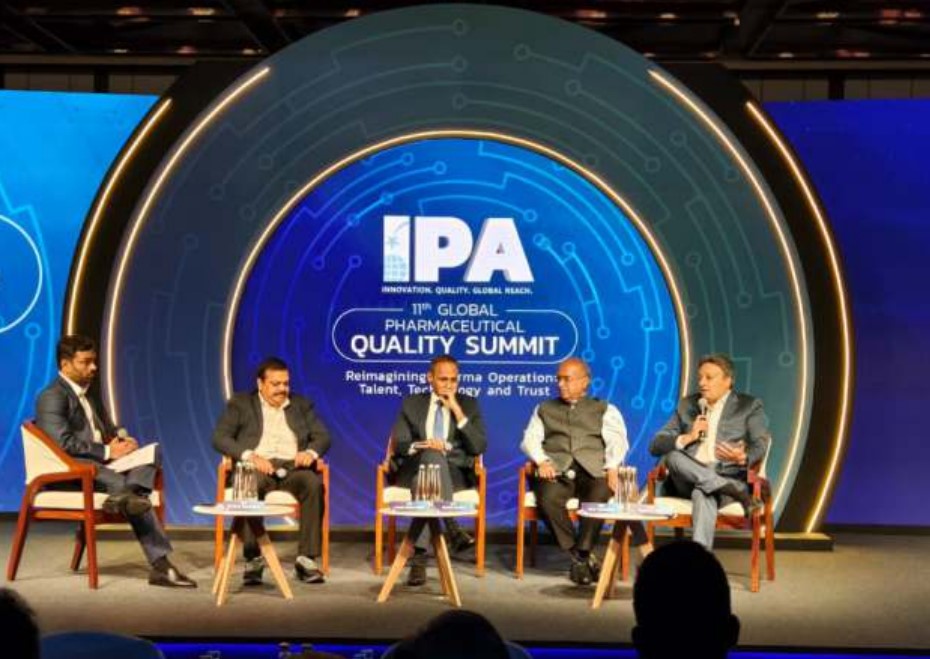
The 11th Global Pharmaceutical Quality Summit (GPQS) 2026, organised by the Indian Pharmaceutical Alliance (IPA), brought together global regulators, industry leaders, policymakers, and quality experts to deliberate on the evolving landscape of pharmaceutical quality and innovation. Held over two days, the Summit centred on the theme “Reimagining Pharma Operations: Talent, Technology and Trust”, with discussions focusing on strengthening quality culture, advancing digital and AI-driven systems, and building resilient pharmaceutical operations capable of sustaining global trust. The event featured keynote addresses, leadership panels, and expert perspectives on the future of India’s pharmaceutical ecosystem, while also recognising excellence and emerging talent in pharmaceutical science and quality advancement.
Global forum on pharmaceutical quality
The Indian Pharmaceutical Alliance (IPA) concluded the 11th Global Pharmaceutical Quality Summit (GPQS) 2026 on 24 February. The two-day gathering brought together more than 400 participants and over 50 speakers, including international regulators, industry leaders, policymakers and experts in pharmaceutical quality. Discussions focused on the future of pharmaceutical manufacturing, regulatory trust, and operational excellence.
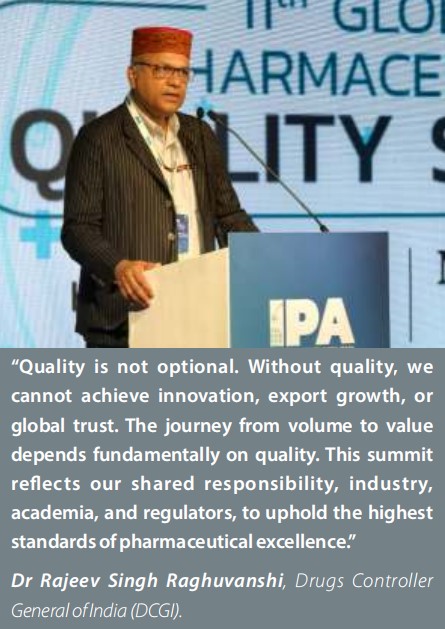
Union Minister for Health & Family Welfare and Chemicals & Fertilizers Jagat Prakash Nadda delivered the keynote address, while the inaugural remarks were presented by Dr Rajeev Singh Raghuvanshi, Drugs Controller General of India (DCGI).
The Union Health Minister described the Summit as a reflection of India’s commitment to move from being the ‘Pharmacy of the World’ to becoming the ‘Innovator of the World’. Referring to the Biopharma Shakti initiative, with an outlay of Rs. 10,000 crore, he said it aims to position India as a global biopharmaceutical manufacturing hub by strengthening domestic production, expanding research capacity, establishing more than 1,000 accredited clinical trial sites, and reinforcing CDSCO as a globally aligned scientific review cadre.
Dr Raghuvanshi highlighted the centrality of quality in India’s pharmaceutical ambitions. He said, “Quality is not optional. Without quality, we cannot achieve innovation, export growth, or global trust. The journey from volume to value depends fundamentally on quality. This summit reflects our shared responsibility, industry, academia, and regulators, to uphold the highest standards of pharmaceutical excellence.”
He also referred to regulatory efforts to address issues such as the cough syrup contamination incidents and the steps taken by authorities to strengthen oversight.
Quality as the foundation of global trust
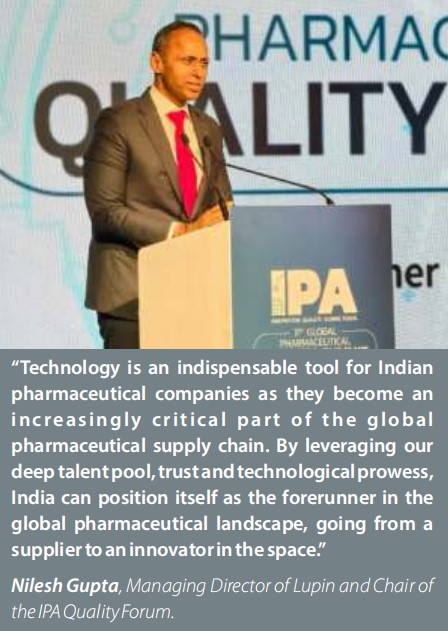
Nilesh Gupta, Managing Director of Lupin and Chair of the IPA Quality Forum, said that India’s pharmaceutical sector has expanded significantly in the past decade, with more than 750 manufacturing sites inspected by the US FDA and strengthened compliance under the revised Schedule M guidelines.
“Indian pharma has transformed remarkably over the past decade, expanding its global footprint with over 750 US FDA-inspected sites and strengthened systems under revised Schedule M. Measurable improvements in regulatory outcomes, data integrity, and governance demonstrate our sustained commitment. But beyond the numbers lies a deeper truth: quality is not a checklist. Quality is a culture. As India moves from volume to value leadership, trust will be our most strategic asset,” he said.
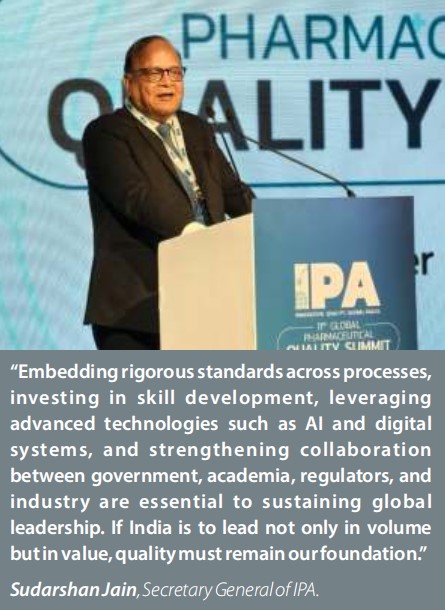
Sudarshan Jain, Secretary General of IPA, emphasised India’s role as a major supplier of medicines worldwide.
“India supplies affordable, quality-assured medicines and vaccines to more than 200 countries. While scale demonstrates capability, it is quality that builds trust. Embedding rigorous standards across processes, investing in skill development, leveraging advanced technologies such as AI and digital systems, and strengthening collaboration between government, academia, regulators, and industry are essential to sustaining global leadership. If India is to lead not only in volume but in value, quality must remain our foundation,” he said.
Technology, talent and the future of pharma operations
Across multiple sessions, speakers highlighted the increasing importance of digitalisation, data integrity frameworks, and AI-enabled quality systems in building resilient pharmaceutical operations. Continuous manufacturing and advanced analytics were also identified as key enablers for future-ready production systems.
During the Summit, Nilesh Gupta emphasised that the combination of advanced technology and skilled talent will be crucial in strengthening global trust and sustaining operational excellence. He noted that a decade of focused efforts has raised industry standards and that aligning innovation with a strong quality culture will be essential for India’s leadership in global pharmaceuticals.
He also outlined how India’s large talent base, combined with technological capability, can help the country evolve from being a major supplier of medicines to becoming a leading innovator in the global pharmaceutical supply chain.
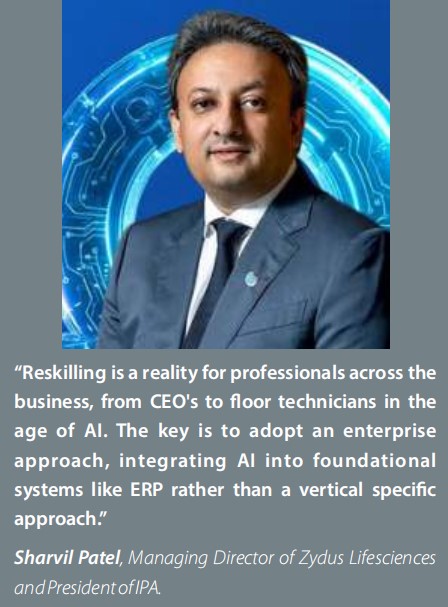
Sharvil Patel, Managing Director of Zydus Lifesciences and President of IPA, highlighted the importance of building organisations that are prepared for an AI-driven future. He emphasised that companies must develop integrated systems where technology, workforce capabilities and operational processes evolve together to create scalable and resilient pharmaceutical enterprises.
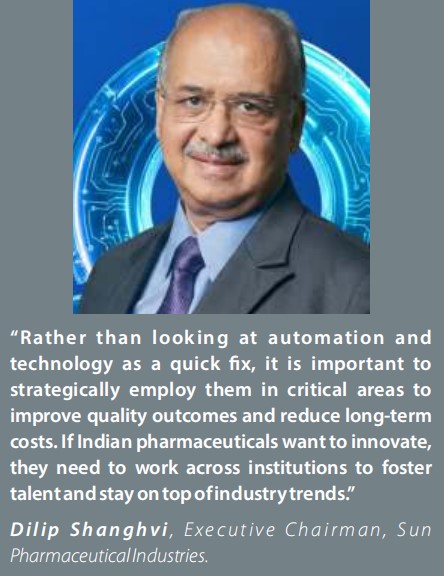
Dilip Shanghvi, Executive Chairman of Sun Pharmaceutical Industries, noted that technological adoption should be viewed as a long-term strategic investment rather than a quick solution. According to him, stronger collaboration across institutions and continued investment in talent development are essential for achieving innovation and operational efficiency. Aligning automation with quality outcomes, he added, can help balance productivity with cost sustainability.
AI adoption and enterprise transformation
Industry experts also discussed the growing impact of artificial intelligence across the pharmaceutical value chain.
Vishnukaant Pitty, Partner at McKinsey & Company, observed that AI adoption in pharmaceuticals is moving from experimentation to execution. The focus, he said, is increasingly on integrating AI across functions and ensuring that systems operate reliably at scale.
Noshir Kaka, Senior Partner at McKinsey & Company, outlined several strategic areas where AI can drive transformation across the life sciences ecosystem. These include accelerating innovation through “self-driving science” in research and development, creating integrated and largely automated supply networks in operations, enabling more personalised engagement in commercial functions, and developing more autonomous enterprise systems in corporate functions.
Leadership dialogue on India’s pharma future
A leadership panel titled “Navigating the Future of India Pharma: Talent, Technology, and Trust” brought together leading industry voices, including Madan Mohan Reddy of Aurobindo Pharma, Nilesh Gupta of Lupin, Dilip Shanghvi of Sun Pharmaceutical Industries, and Sharvil Patel of Zydus Lifesciences. The session was moderated by Sathya Prathipati, Senior Partner at McKinsey & Company.
The discussion explored how India’s pharmaceutical sector can strengthen its global leadership by building a future-ready workforce, accelerating the adoption of digital and AI technologies, and reinforcing a strong culture of quality. Speakers stressed that sustained competitiveness would require aligning innovation, operational excellence, and regulatory credibility with a strong commitment to patient-centricity and continuous skill development.
Best practice guidance and industry initiatives
During the Summit, the IPA released three Best Practice Guidance documents aimed at strengthening operational standards across the pharmaceutical industry:
- Sustainability in the Pharmaceutical Industry
- Logistics and Transportation Worthiness for Pharmaceutical Product Packaging
- Prevention of Contamination in Pharmaceutical Manufacturing
These guidance documents are intended to support companies in enhancing compliance, operational resilience, and environmental responsibility.
Recognising excellence and emerging talent
The Summit also recognised contributions to pharmaceutical science and quality advancement.
For the first time, IPA introduced the Lifetime Achievement Award in Academia, honouring distinguished contributions to pharmaceutical science. The award was presented to Dr B. Suresh by Sharvil Patel for his long-standing work in advancing pharmaceutical education and quality standards.
The Hackathon Winning Presentation Award was presented to the champion team from the Institute of Chemical Technology, Mumbai. The second runner-up position was secured by the National Institute of Technology, Andhra Pradesh, while the third runner-up honours were jointly awarded to K.B. Institute of Pharmaceutical Education and Research and L.M. College of Pharmacy.
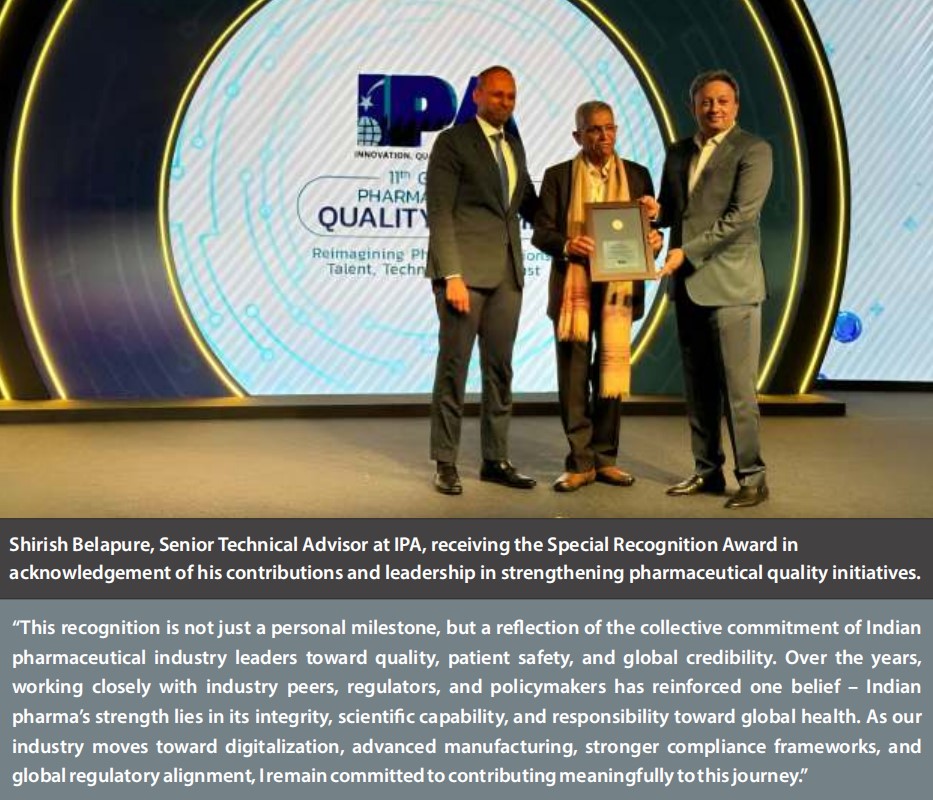
In addition, a Special Recognition Award was conferred upon Shirish Belapure, Senior Technical Advisor at IPA, acknowledging his contributions and leadership in strengthening pharmaceutical quality initiatives.
In his concluding remarks, Sharvil Patel emphasised that quality must remain central to the industry’s mission.
He said that quality is not simply about compliance but represents a commitment to public health and to global patients. He also stressed the importance of continued investment in talent, adoption of AI-driven excellence, and strengthening manufacturing capabilities to enable future growth and innovation.
A growing global platform
Since its launch in 2016, the Global Pharmaceutical Quality Summit has evolved into an important international platform for advancing pharmaceutical quality. It brings together regulators, industry leaders, and technical experts to address emerging challenges and share best practices in compliance, manufacturing and innovation.
In February 2025, IPA hosted the 10th edition of the Summit under the theme “Navigating the Next Decade for Global Excellence”. The event featured more than 50 speakers across 11 sessions, covering topics such as digital transformation, supply chain resilience, artificial intelligence in manufacturing, and sustainability.
The 11th edition continued this trajectory, with the opening day setting the stage for forward-looking discussions on the evolving role of quality systems, digital technologies and operational transformation across the pharmaceutical ecosystem. Speakers emphasised that strengthening quality culture, organisational readiness and technology integration will be crucial in building resilient and globally trusted pharmaceutical operations.