

G-R08P53QMSP
By Adv. Shoeb Masodi
Innovation in the healthcare sector is evolving faster than ever. This includes not only pharmaceutical formulations but also pharma machinery manufacturing, formulation R&D, surgical product manufacturing, surgical equipment development, and the engineering of machines used to manufacture surgical products. Across all these segments, companies invest enormous resources in proprietary designs, engineering improvements, formulation technologies, process optimization, material innovation, and regulatory-compliant manufacturing systems. In such a highly technical and competitive industry, securing exclusive rights over your innovation is no longer a luxury; it is a fundamental business requirement.
Once an invention/innovation is made, the creator can acquire Patent Protection. An acquired patent offers the inventor/creator many benefits and advantages in the industry:
Whether a company designs an advanced granulation system for pharmaceutical production, develops a novel extended-release formulation, engineers a new laparoscopic device, or creates an automated assembly line for surgical disposables, each form of innovation represents a major investment of time, effort, and money. These innovations become valuable assets only when they are legally protected. Otherwise, they remain vulnerable to imitation by any competitor who wishes to benefit from your research and engineering work without incurring any of the development costs.
By securing protection over your technology, whether it is a mechanism inside a surgical instrument, a formulation process that enhances stability, a machine architecture that improves productivity, or a new sterilization technique, you ensure that nobody can replicate or commercialize your work without your permission. This gives your business a solid foundation for long-term growth and market strength.
Healthcare manufacturing industries often face intense competition, especially in areas such as pharmaceutical machinery, surgical equipment, and formulation development. Competitors try to replicate machine designs, reverse-engineer components, copy formulations, or imitate the working principles of surgical devices. If your technology is protected, you hold exclusive rights over the innovation, which means you control who can produce it, who can use it, and how it can enter the market.
This exclusivity creates a competitive edge that competitors cannot cross. Even if they attempt to reverse-engineer or modify your invention, your protection acts as a legal shield that prevents them from exploiting your innovation. This control gives you pricing power, long-term product stability, and a guaranteed edge in both domestic and international markets.
Investors in healthcare, whether they fund pharma machinery companies, med-tech startups, formulation labs, or surgical equipment manufacturers, look for businesses with strong foundations and future-proof assets. Protected innovation ensures that your business possesses something unique that cannot be duplicated by others. This reduces market risk for investors and increases their confidence in funding your equipment line, formulation technology, or product R&D.
For a machinery manufacturer, for example, a protected machine design assures investors that low-cost replicas cannot flood the market and destroy margins. For a formulation or medical-device company, exclusive rights demonstrate that the product has long-term commercial potential and is insulated from competition. As a result, investors are more willing to provide capital, join as strategic partners, or support expansion.
In today’s healthcare ecosystem, business valuation depends heavily on intellectual property assets. The value of a pharma formulation lab, surgical device manufacturer, or medical machinery company is not determined only by its revenue; it is significantly influenced by the exclusivity of its technology and the strength of its secured rights.
A company that owns exclusive rights over its product or machinery immediately gains higher market recognition. Clients, hospitals, distributors, and international buyers view the product as technologically advanced and “state-of-the-art.” This improves brand perception, enhances credibility, and positions the business as a leader in innovation. Over time, this recognition supports higher valuation, better negotiation leverage, and stronger opportunities for mergers, acquisitions, or global partnerships.
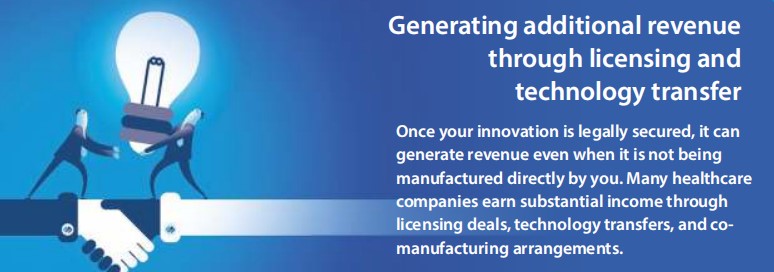
Once your innovation is legally secured, it can generate revenue even when it is not being manufactured directly by you. Many healthcare companies earn substantial income through licensing deals, technology transfers, and co-manufacturing arrangements. For example, a pharma machinery company may license its optimized filling system to overseas manufacturers. A formulation R&D team may license a novel composition to pharmaceutical companies. A surgical-device developer may allow another manufacturer to produce under a licensing agreement in return for royalties.
In all such scenarios, your protected innovation becomes a continuous revenue generator. This transforms your R&D investment into a long-term financial asset.
Many healthcare companies initially think that securing exclusive rights is an expense. In reality, it is one of the highest-return investments a business can make. The healthcare sector requires heavy spending on R&D, prototype development, formulation trials, clinical or field testing, stability studies, sterilization validation, regulatory compliance, and repeated machine optimization. After this comes the cost of certifications such as GMP, CDSCO approval, ISO, CE, and other technical validations.
Without protection, all this investment becomes vulnerable because any competitor can copy the results of your long and costly development journey. With protection, however, you recover many times the amount you invested because your product or machine enjoys exclusive status in the market. You gain pricing control, market dominance, long-term sales, and licensing rights—all of which multiply the value of your initial R&D efforts.
In simpler terms: you do not protect your innovation for today; you protect it for the future earnings it will generate.
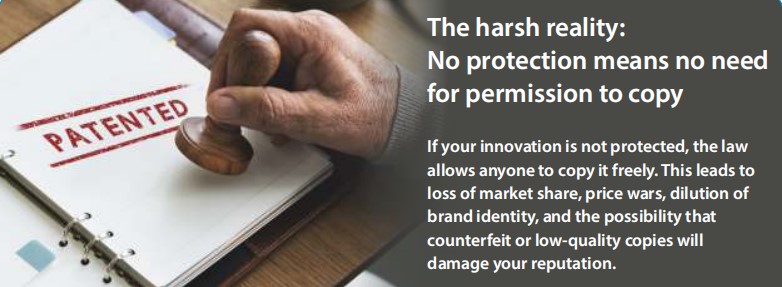
If your innovation is not protected, the law allows anyone to copy it freely. A competitor can reproduce your pharma machine design, imitate your surgical device mechanism, duplicate your formulation, or replicate your manufacturing process without needing your approval, acknowledgment, or payment. This leads to loss of market share, price wars, dilution of brand identity, and the possibility that counterfeit or low-quality copies will damage your reputation.
In industries like healthcare, where precision and safety matter, such copying can also put end users at risk, yet the commercial damage is suffered by the original innovator who invested in the development work.
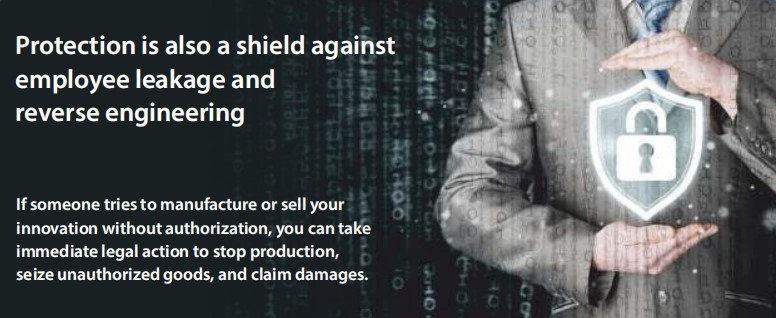
Many companies in pharma machinery and surgical equipment manufacturing face the challenge of employees moving to competitors or starting their own businesses after learning internal processes. Similarly, competitors often attempt to break down your machine, study its components, and recreate it. Protection gives you the legal power to prevent such misuse. If someone tries to manufacture or sell your innovation without authorization, you can take immediate legal action to stop production, seize unauthorized goods, and claim damages.
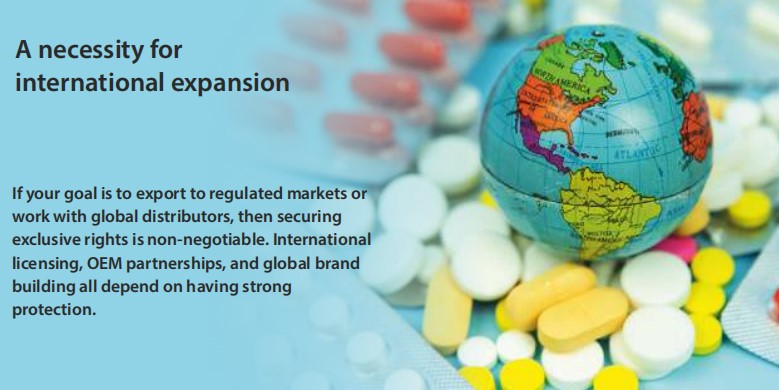
If your goal is to export to regulated markets or work with global distributors, then securing exclusive rights is non-negotiable. Most countries, importers, and international technical partners require proof of technology ownership before onboarding a company. Without this, exporting machinery, formulations, or surgical equipment becomes difficult, risky, or impossible. International licensing, OEM partnerships, and global brand building all depend on having strong protection.
The healthcare industry, including pharmaceutical machinery manufacturing, formulation R&D, surgical product manufacturing, surgical equipment engineering, and surgical-machinery design, runs on innovation, precision, and trust. Protecting your innovation ensures market exclusivity, higher valuation, investor confidence, competitive dominance, and long-term financial returns. When you secure your technology, you secure the future of your business.
If you wish to understand how protection applies specifically to your machine, formulation, device, or manufacturing process, or if you have questions regarding enforcement or international expansion, M&P IP PROTECTORS, Office of Intellectual Property Law, is always available to guide you with complete clarity and strategic support.
ABOUT THE AUTHOR
Adv. Shoeb Masodi is an experienced Intellectual Property attorney handling trademark, patent, and domain name disputes, along with strategic IP portfolio management. He has represented global brands such as Apple (FaceID arbitration), Manchester United, Xiaomi, TP-Link, AMUL, KP Group, and Parimatch in high-value IP matters. He appears regularly before the Hon’ble Gujarat High Court and subordinate courts and is a mentor at the MeitY Startup Hub as well as a registered IP Facilitator under Startup India and SSIP. Shoeb is recognized as a WIPR Young IPR Leader 2025 and an IAM300 Global IP Strategist 2025.
M&P IP PROTECTORS is a full-service IP law firm co-founded by Shoeb Masodi and Mahendra Parmar, providing end-to-end solutions in trademarks, patents, designs, copyrights, IP enforcement, litigation, and domain name disputes. The firm serves clients across technology, manufacturing, FMCG, pharmaceuticals, surgical products, surgical equipment and surgical machine manufacturing, and the startup ecosystem.