
G-R08P53QMSP DESIGN PATENTS - Pharma Machines & Technology

Pharma Machines & Technology

DESIGN PATENTS

The Most Underrated Power Tool in Healthcare Manufacturing

Why protecting the appearance, and the performance-enhancing design, matters more than ever!

By Adv. Shoeb Masodi

In today’s healthcare manufacturing ecosystem, innovation extends far beyond mechanisms and engineering. Machines, medical devices, surgical instruments, formulation packaging, and equipment components are all shaped through carefully planned design decisions that combine visual uniqueness with functional advantages. In industries such as pharma machinery manufacturing, surgical device production, medical equipment engineering, and formulation packaging, the outer design is no longer just an aesthetic choice; it is a strategic technical decision that directly affects usability, ergonomics, safety, handling, aerodynamics, efficiency, and overall product performance.

This is where Design Patent (Industrial Design Registration) becomes essential. While it protects the “appearance” of an article, the appearance itself often arises from deliberate engineering choices that improve the product’s application, handling, or efficiency. Securing protection ensures that your competitors cannot copy those design-driven functional benefits simply by recreating the same external geometry.

Design is not just about looks; in healthcare, design improves performance

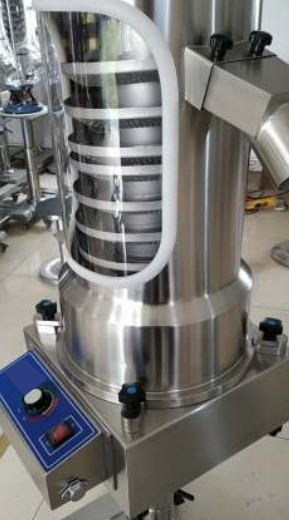
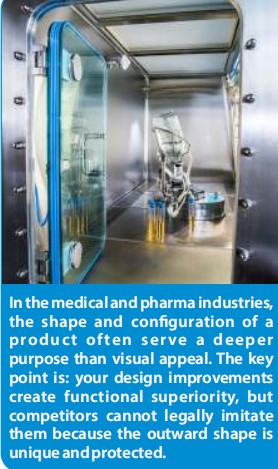
In the medical and pharma industries, the shape and configuration of a product often serve a deeper purpose than visual appeal. For example, a surgical instrument may have a uniquely contoured handle, not for decoration, but to provide a superior grip, reduce hand fatigue, distribute pressure more naturally, and allow surgeons to operate with better stability. Similarly, a pharma machine component such as a rotary blade, impeller, or airflow-guiding part may be shaped aerodynamically to reduce resistance, improve smooth rotation, enhance air flow patterns, or increase precision during operation.

These functional advantages arise from design-driven decisions: the geometry, curves, angles, tapering, surface contours, and external shaping. Even though these designs deliver functional benefits, law allows them to be protected as Industrial Designs as long as the protection is sought for the visual form, not the underlying mechanical principle. The key point is: your design improvements create functional superiority, but competitors cannot legally imitate them because the outward shape is unique and protected.

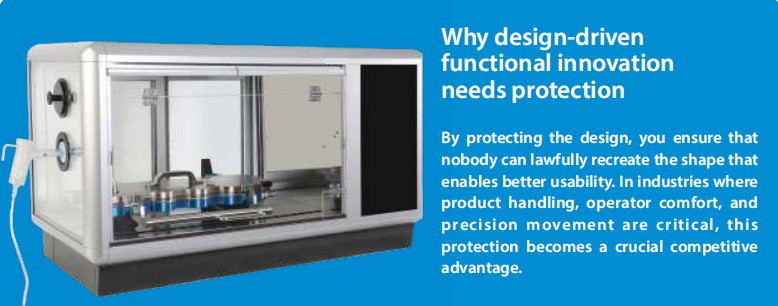
Modern healthcare companies invest significant engineering effort into developing products whose outer shape contributes to performance. A handle designed with ergonomic finger rests, a medical device casing shaped to improve airflow or cooling, a surgical instrument with a unique curvature for controlled movement, or a pharmaceutical machine housing designed to reduce vibration or noise – these are all examples where appearance and performance merge seamlessly.

Such design-driven functional improvements cannot depend solely on mechanism protection. Many of them are not purely “functional inventions,” yet they give enormous advantage to the user. They represent the industrial design philosophy behind modern healthcare products: performance delivered through thoughtful geometry.

Industrial Design Registration allows companies to own this geometry exclusively, ensuring that competitors cannot replicate the shape, contour, pattern, or configuration that gives your product its performance edge.

In the healthcare industry, competitors often find it easier to copy the outer shape of a successful product rather than replicate its internal engineering. A surgical tool with a uniquely shaped handle, a pharma machine blade with a signature aerodynamic profile, a medical device shell designed for a stable grip, or a packaging bottle shaped to assist in controlled dosage, all these can be visually duplicated even if the internal mechanism is not easy to reproduce.

By protecting the design, you ensure that nobody can lawfully recreate the shape that enables better usability. Even if the competitor tries to claim that they are not copying your mechanism, your protection allows you to stop the imitation purely on the basis of outward similarity. In industries where product handling, operator comfort, and precision movement are critical, this protection becomes a crucial competitive advantage.

When a product’s outer structure is thoughtfully engineered, whether it is the casing of a machine, the contour of a surgical instrument, the aerodynamic profile of a rotating component, or the geometry of a device used in formulation, the result is a product that is not only visually distinct but functionally superior. Protecting this identity ensures that your product’s advantage is not diluted by look-alike competitors who piggyback on your design work.

Hospitals, operators, technicians, and international buyers often recognise equipment through its external structure. A protected design reinforces market trust because it reflects originality, engineering investment, and quality assurance. Your design becomes a signature, a form that people associate with performance and reliability.

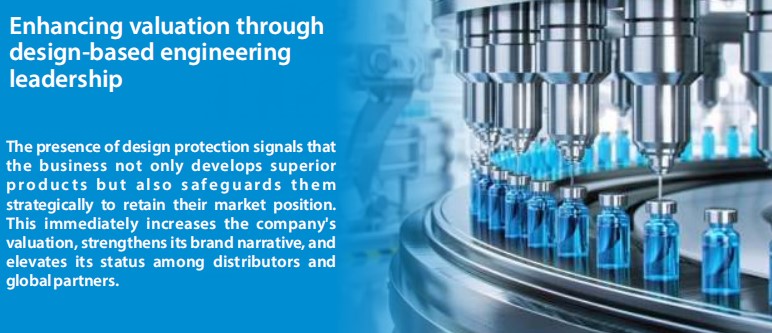
A company that invests in developing ergonomic, performance-enhancing, or user-optimised designs builds a reputation of engineering excellence. Investors recognise such companies as more innovative, more reliable, and more future-ready. The presence of design protection signals that the business not only develops superior products but also safeguards them strategically to retain their market position.

This immediately increases the company’s valuation, strengthens its brand narrative, and elevates its status among distributors and global partners. A protected design becomes an asset, one that cannot be reproduced, altered superficially, or hijacked by competitors to create confusion in the market.

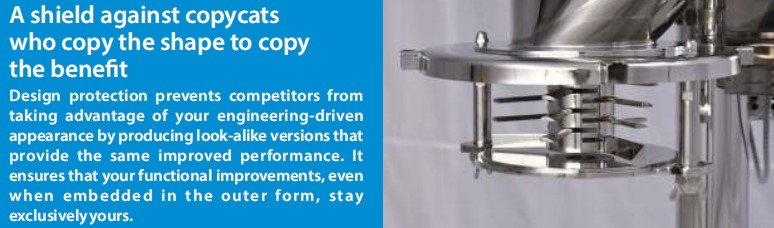
In many healthcare products, copying the shape means copying the benefit. For example, a surgically designed handle with special curves for better control, once imitated, gives the competitor the same operational advantage your team spent years perfecting. A pharma machine blade shaped for reduced turbulence, if copied visually, offers the same efficiency to a competitor without their investment in testing and development.

Design protection stops this entirely. It prevents competitors from taking advantage of your engineering-driven appearance by producing look-alike versions that provide the same improved performance. It ensures that your functional improvements, even when embedded in the outer form, stay exclusively yours.

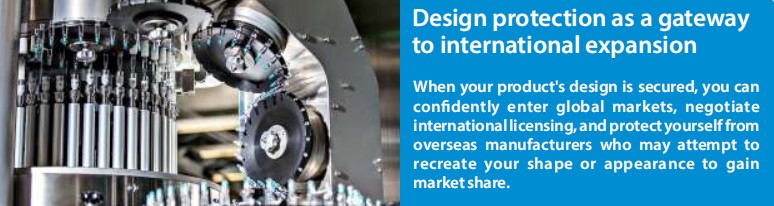
For companies planning to export pharma machines, surgical devices, or medical equipment, having protected design-based improvements becomes a major advantage. Many countries require proof of design exclusivity, particularly in medical fields where the external geometry often reflects safety, handling control, and user protection.

When your product’s design is secured, you can confidently enter global markets, negotiate international licensing, and protect yourself from overseas manufacturers who may attempt to recreate your shape or appearance to gain market share.

Conclusion

Design innovation in healthcare and medical manufacturing is not limited to external beauty – it is one of the strongest forces behind better usability, safer operation, ergonomic comfort, improved air dynamics, stabilised handling, and engineering-driven performance. When these improvements come to life through the shape, contour, geometry, or configuration of a product, Industrial Design protection becomes essential.

By securing the visual expression of your technical design, you safeguard both your competitive advantage and your engineering achievement. You prevent competitors from copying the very form that enables your product to perform better. You strengthen your brand, your valuation, and your technological identity.

For guidance on securing your product design, protecting your engineering-driven aesthetics, or understanding international filing strategies, M&P IP PROTECTORS, Office of Intellectual Property Law, is always ready to support you with clarity and expertise.