


Pharma Machines & Technology

Redefining NDCs for the Future of Traceability

Why an Important Medicine Code Had to Change

By Rameshwar Verma

A small code sits behind every medicine and when it could no longer keep up, everything was affected. The article highlights the impact of the FDA’s 12-digit NDC standardization on pharmaceutical traceability, compliance, and patient safety, with practical insights for industry professionals.

When an Identifier Became Invisible

Every medicine has a name. Every medicine pack has a label. But behind every label is something most patients have never seen – an identity code that tells the healthcare system exactly what that medicine is. In the United States, this code is called the National Drug Code, or NDC.

For decades, the NDC quietly held the pharmaceutical system together. It supported drug approvals, insurance billing, pharmacy dispensing, recalls, safety reporting, and market tracking. It did its job so well that most people stopped thinking about it.

For a long time, the system worked. Then the world around it changed. The pharmaceutical world moved fast. Over the last two decades, the pharmaceutical supply chain has transformed:

  • Supply chains became digital
  • Medicines became serialized, pack by pack
  • Systems began exchanging data instantly
  • Automation replaced manual checks

Yet the NDC remained largely unchanged…

What once brought clarity began to create confusion. The NDC was asked to serve new digital systems without being redesigned for them. Gradually, a foundational identifier became almost invisible, until problems made it visible again.

Why the NDC Matters More Than It Appears

While the NDC is a U.S.-specific identifier, its impact reaches global manufacturing, supply chains, and data systems. The NDC is not just a number printed on a package. It is the common language shared by regulators, manufacturers, wholesalers, pharmacies, payors, and safety and monitoring systems.

The NDC connects the full life of a medicine from approval to patient. If the NDC is wrong, inconsistent, or misunderstood, insurance claims cannot be processed, recalls become slow and incomplete, safety signals are harder to detect, and track & trace systems stop working.

When product identity breaks, entire systems break with it.
Buiflt or a Simpler Time

The NDC was created in an era when there were fewer medicines, supply chains were mostly local, automation was limited, and control happened mainly at batch level.

It used 10 digits, but not one standard format. Instead, there were multiple structures: 4-4-2, 5-3-2, 5-4-1. Leading zeros mattered, formats differed, and systems interpreted them differently. Humans could manage this complexity, but machines could not. Digital systems require consistency, precision, and unambiguous rules.

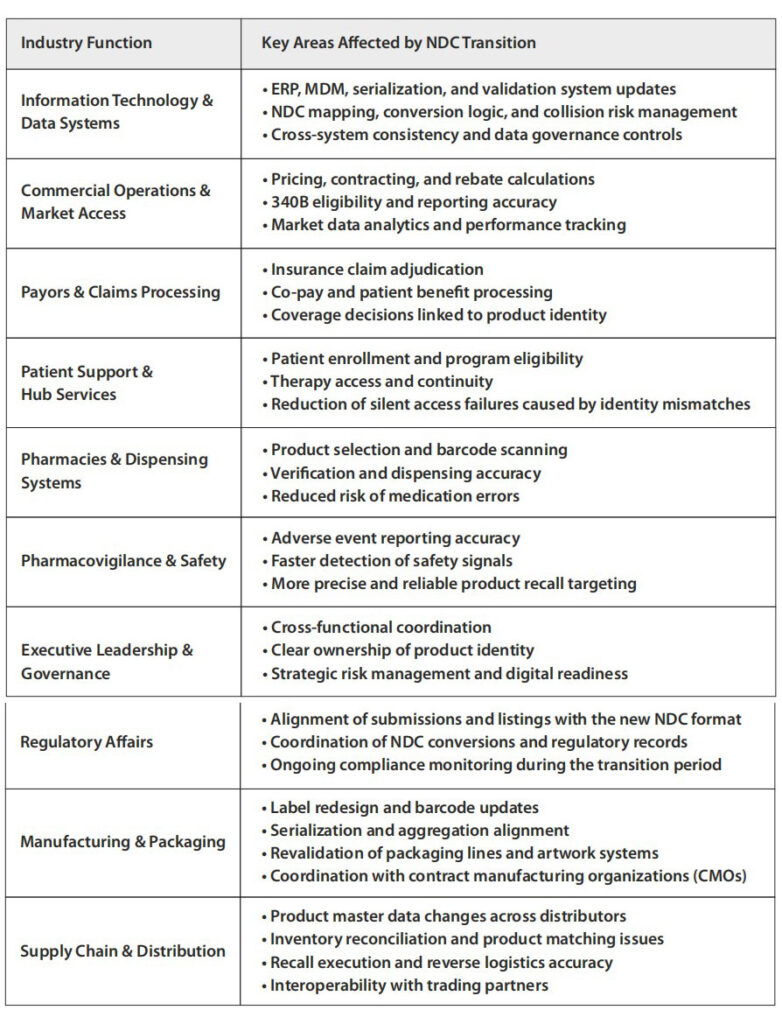
Affected Parts of the Pharmaceutical Industry

The NDC transition affects far more than labeling. Because the NDC sits at the center of product identity, its impact reaches across the entire pharmaceutical ecosystem.

When Format Becomes Risk

As healthcare systems digitized, format issues led to real problems, including claims being rejected without clear reasons, inventory data failing to match, recalls taking longer than necessary, and manual corrections creating new errors.

What looked like a technical inconvenience became something far more serious: fragmented product identity. In healthcare, identity issues rarely stay contained. Eventually, they reach patients.

Patient Safety at Stake

Multiple NDC formats increased the risk of dropped leading zeros, wrong drug selection, barcode scan failures, and manual data entry errors. These are not theoretical risks. They can lead to medication errors. When patient safety is involved, uncertainty is unacceptable.

The Regulatory Turning Point

In March 2026, the U.S. Food and Drug Administration (FDA) acted. It issued a final rule requiring a single, standardized 12 digit NDC format for all medicines. This was not a cosmetic change; it was a structural reset.

The goal was clear: Stabilize product identity in a highly automated, high risk healthcare system.

What the New 12 Digit NDC Changes

The new rule introduces:

  • One universal 12 digit format (6-4- 2)
  • One consistent structure for all products
  • Automated conversion of existing NDCs
  • Elimination of leading zero confusion
  • Better support for barcodes and serialization

It is a technical change with deep operational, financial, and safety impact.

From Complexity to Clarity

Moving from many 10 digit formats to one 12 digit format reduces misinterpretation across systems, errors in automated processing, manual corrections, and delays in recalls and verification. One standard means fewer mistakes and more trust.

The Hidden Pressure: Running Out of Codes

Few people noticed another growing issue: labeler code exhaustion. The old 5 digit labeler code was running out of available numbers. Within 10–15 years, there would not be enough codes for new products.

That would limit growth. By expanding to a 6 digit labeler code, capacity increased from about 100,000 to nearly 1,000,000 possibilities, supporting innovation for decades to come.

Why DSCSA Made Identity Non Negotiable

The Drug Supply Chain Security Act (DSCSA) raised the bar. It requires unique product identifiers, machine readable data, and end to end traceability

The NDC is part of this identifier. If the NDC is unstable, serialization fails, verification breaks, and traceability becomes unreliable. A secure supply chain cannot exist without strong identity.

More than Compliance

The FDA provided seven years before enforcement and three years for transition, reflecting how deeply the NDC is embedded in every system. Forward-thinking organizations see this as an opportunity to clean master data, align ERP and MDM systems, strengthen payer and EHR integration, speed up recalls, and improve global identifier alignment.

NDC reform is not just regulatory; it is a test of digital readiness.

When Identity Quietly Breaks Revenue

Not all failures are visible. Some move silently through claims systems, patient assistance programs, market analytics, and access workflows. The revenue loss often appears long after the root cause.

Zero Prefix Collisions: A Silent Risk

During conversion, systems sometimes add leading zeros. In some cases, this causes two different products to end up with the same 12 digit result called a zero prefix collision.

Studies have identified over 4,000 potential collisions, and around 270 involving high risk medicines. These issues already exist in current data and may go unnoticed.

Where the Business Feels It First

Systems do not usually fail loudly; they misroute data. This leads to claim denials, lost co-pay benefits, broken patient programs, 340B reporting issues, pricing errors, and distorted market data.

Everything looks operational, but the outcomes tell a different story.

Patients Experience the Impact First

Patients face delayed treatments, missed refills, enrollment problems, and confusion at the pharmacy. Identity failures become access problems and access problems damage trust.

Serialization Did Not Create the Risk

Serialization did not cause these issues; it revealed them. As labeler codes expand, NDCs no longer fit neatly inside older data structures. A serial number may verify correctly while the product identity behind it does not. Serialization exposes weak identity rather than hiding it.

Why This Feels Like a Supply Chain Reckoning

At first glance, the transition seems simple, requiring only the addition of digits, updating labels, and modifying barcodes. In reality, the NDC underpins everything, and changing it causes the entire ecosystem to respond.

Why Leaders Compare It to Y2K

Not because systems will collapse overnight, but because systems are deeply connected. Every data handoff relies on shared identity. Problems appear only when everything goes live. The real risk is not lack of awareness; it is late coordination.

Preparedness Defines Success

Organizations that prepare for early gain faster launches, fewer billing issues, stronger partner confidence, cleaner data, and more resilient operations. Those that delay will struggle longer and recover slower.

The Real Challenge Is Governance

Technology will adapt, but coordination is harder. Success depends on clear ownership, cross-functional leadership, early partner engagement, and strong identity governance. This is not just a labeling project; it is a business transformation.

What This Change Truly Represents

NDC reform is not about numbers; it is about precision. Precision creates visibility, accountability, and trust. Trust does not tolerate ambiguity.

Closing Insight

  • Track & Trace depends on identity.
  • Serialization depends on accuracy.
  • Patient safety depends on trust.

And trust begins with a code that is always clear. In today’s pharmaceutical supply chain, identity is no longer a label. It is the foundation of accountability.

The future of medicine tracking will be shaped by companies that act early, not those that wait for deadlines. Getting product identity right today helps protect patients, revenue, and trust tomorrow.

ABOUT THE AUTHOR

Rameshwar Verma is Executive – Packing with 11+ years of experience in pharmaceutical packaging, serialization, and compliance. He works on DSCSA, EU FMD, CSV, and Industry 4.0. He focuses on simple leadership, improving packaging efficiency, solving serialization issues, and supporting audits. He is the author of Basic Concepts of Track and Trace System for Pharmaceutical Industry and Pharmaceutical Track and Trace System: A Guide to Optimizing Efficiency and Compliance.