

Pharma Machines & Technology

Building a Sustainable Quality Culture in Life Sciences

Quality culture is a term frequently invoked in life sciences leadership discussions, regulatory dialogues, and strategic planning – yet many organizations struggle to translate the concept into consistent behaviours and measurable outcomes. This article distils insights from quality specialist Craig Jacobs on what quality culture means in practice, why it resists easy measurement, and how leaders and quality professionals can foster sustainable, accountable cultures across their organizations. Drawing on the “Four Ps” framework purpose, people, process, and performance – the discussion offers practical guidance for embedding quality into everyday work, shifting accountability beyond the quality function, and designing metrics that reinforce rather than undermine desired behaviours.


Craig Jacobs
 is a Quality Culture Momentum Specialist at Afferm8 Consultancy, where he works with life sciences organizations to assess and strengthen quality culture. Affirm8 offers a free Quality Health Check – an online survey assessing practices across the Four Ps framework – available at their website.

The concept of quality culture appears regularly in regulatory guidance, inspection reports, and corporate strategy documents. Yet despite its prominence, many life sciences organizations find that quality culture remains elusive – something talked about in boardrooms but inconsistently reflected on the shop floor.

Craig Jacobs, Quality Culture Momentum Specialist at Afferm8 Consultancy, offers a deceptively simple definition: quality culture is what happens when no one is watching. When a manager observes a production line, operators complete their checks, document their work, and follow procedures. The true test comes when the observer walks away. If checks quietly stop, paperwork is skipped, or shortcuts become normalized once direct oversight is removed, then whatever is on paper does not reflect the true culture.

The contrast between day and night shifts provides a useful reference point. Night shifts typically have less oversight, and differences in behaviour can reveal whether quality is genuinely embedded or merely performed under pressure. The output of processes when people are not “staring at it with a microscope” is the most honest indicator of quality culture.

The Measurement Challenge

One reason organizations struggle with quality culture is that it resists easy quantification. People close to the work – those “at the coal face” – experience culture daily. They know whether they are listened to, whether mistakes are punished or learned from, and whether quality is seen as everyone’s responsibility or a separate gatekeeping function. Senior leaders, often more removed from frontline realities, can become frustrated with culture discussions precisely because they lack clear metrics.

To address this gap, Chris and his team have developed a structured assessment approach built around four dimensions: purpose, people, process, and performance.

Purpose

This dimension examines why the organization has a quality management system (QMS) and what it is trying to achieve. When a new manufacturing line is introduced, do leaders define upfront what “good” looks like – in terms of checks, certifications, and validation? Are change management activities aligned with a clear strategic purpose?

People

This focuses on training, competence, and engagement. Anonymous engagement surveys can be revealing: if a quality or culture survey is sent out and only 30-40% of staff respond – even though it is blind – this may signal fear, distrust, or a lack of psychological safety around the quality function.

Process

This covers the robustness and understanding of core quality processes such as risk management, root cause analysis, and document control. Organizations should be clear about which processes are truly critical and how well they are followed in practice.
Performance

This deals with metrics and KPIs: what the organization measures, whether it has both lead and lag indicators, and how those metrics influence behaviour.

Culture should be treated as a target, not an end state. No company will ever legitimately declare its quality culture “perfect” and relax. Instead, culture is a journey of continual adjustment and rebalancing. Through the Four Ps framework, even organizations with well-developed systems often discover that one or two areas are significantly weaker than the others. Left unattended, those weak points gradually erode culture and undermine the QMS over time.
A recurring theme in quality culture discussions is the tendency to blame the quality function when something goes wrong. In many life sciences organizations, quality is seen as the “boss of quality,” expected to enforce standards, manage audits, and carry the burden when issues arise. Meanwhile, functions directly tied to revenue – production, logistics, commercial operations – may be protected from accountability because their work is perceived as “making the money,” with quality cast as merely a support service.

This pattern is fundamentally about how accountability is distributed. If organizational structures and messages place responsibility for quality primarily on QA or QC, then the rest of the business will naturally defer to them – and blame will follow when problems occur.

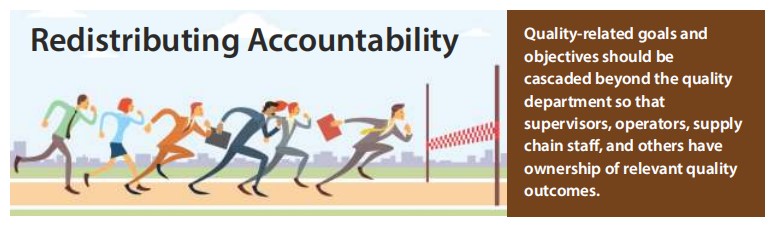
Addressing this requires a much broader sharing of accountability. Quality-related goals and objectives should be cascaded beyond the quality department so that supervisors, operators, supply chain staff, and others have ownership of relevant quality outcomes.

One practical example: in some organizations, when a recall occurs, a quality representative traditionally presents the situation to the wider business, essentially becoming “the face” of the problem. A more effective approach involves bringing the teams directly involved – logistics, manufacturing, or others – into the discussion. Eventually, these teams should be the ones presenting the issue to senior leadership, with quality present to support and provide technical assurance.

The first attempts at this shift are often uncomfortable and sometimes messy, particularly in front of regulators. However, as people grow into the role, genuine accountability develops. Staff understand that if a serious issue arises, they will be expected to explain it clearly and engage in the solution – not simply hand it off to quality.

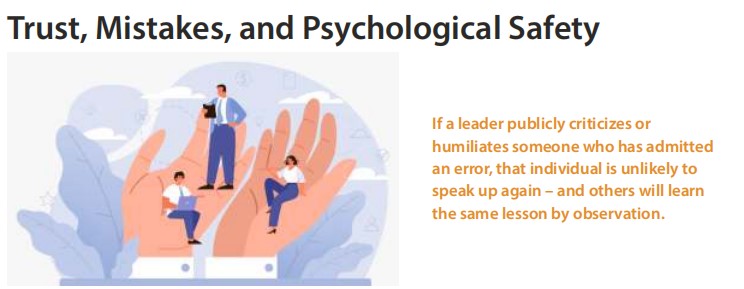
Trust and the handling of mistakes are central to a healthy quality culture. Leaders must allow people to make mistakes in a controlled, risk-assessed environment. If a leader publicly criticizes or humiliates someone who has admitted an error, that individual is unlikely to speak up again – and others will learn the same lesson by observation.

In life sciences, the word “risk” can be uncomfortable, but risk is everywhere and cannot be removed entirely. Instead, organizations should structure work so that failures, when they occur, are detected early, understood, and learned from without causing harm. This requires a mindset in which mistakes are seen as opportunities for learning and improvement – provided that proper risk assessment and safeguards are in place – rather than triggers for blame.

When quality is perceived as a distinct group that appears only for audits, deviations, or approvals, it is inevitably seen as an obstacle rather than a partner.

Quality leaders should resist the temptation to “take over” whenever a quality topic arises. Instead, they should act as facilitators who bring in subject matter experts from supply chain, production, and other functions. When those stakeholders are actively involved in designing quality-related processes, they are much more likely to own and champion the resulting procedures.

Quality professionals, for their part, may need to become more comfortable operating in the “grey area” between strict yes/no interpretations. Rather than always saying “no” and behaving like gatekeepers, they should develop pragmatic judgement and the ability to negotiate acceptable solutions – while still protecting patients and compliance.

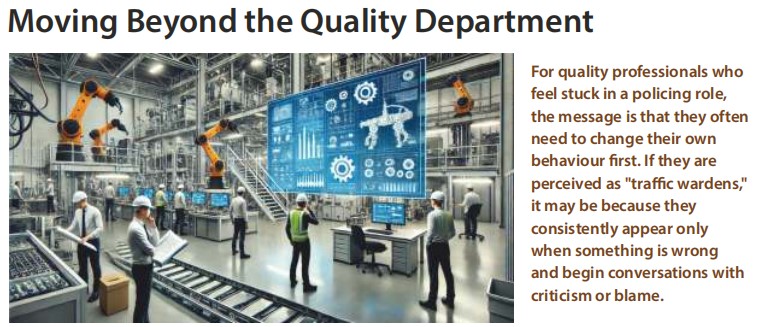
For quality professionals who feel stuck in a policing role, the message is that they often need to change their own behaviour first. If they are perceived as “traffic wardens,” it may be because they consistently appear only when something is wrong and begin conversations with criticism or blame.

A more effective approach involves shifting focus from blaming individuals to understanding processes: asking what in the system is driving non-compliance and how QA can help address it. This can mean visiting the line proactively, asking operators about their challenges, offering help before problems surface, and recognizing that most people want to do a good job but face constraints. Those who have previously worked in operations often excel at this because they understand what pressure looks like at the coal face and can distinguish between chronic system issues and occasional difficult days.

Communication Breakdowns

Communication is another area where frequent breakdowns occur, even in otherwise well-established organizations.

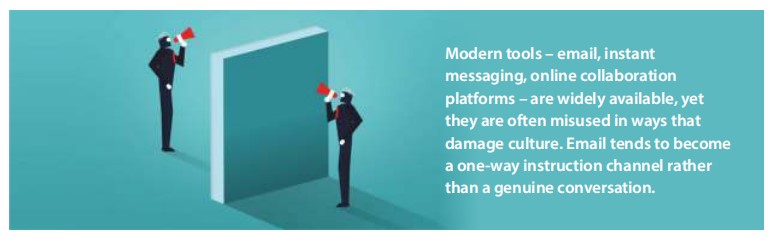
Modern tools – email, instant messaging, online collaboration platforms – are widely available, yet they are often misused in ways that damage culture. Email tends to become a one-way instruction channel rather than a genuine conversation. A short email or Teams message from a senior leader can cause a junior employee to abandon all other work to meet an urgent request, creating hidden disruption elsewhere in the organization.

In theory, these tools allow for two-way communication, but in practice they often reinforce hierarchies and reactivity.

Practical recommendations:

  • Use email primarily to inform, not to conduct complex back-and-forth problem-solving.
  • When responses and nuance are required, pick up the phone, arrange a quick in-person conversation, or use a structured meeting.
  • Regular stand-up meetings, monthly team sessions, and facilitated workshops provide the two-way dialogue that culture relies on.
  • Standardize how messaging platforms are used – for instance, creating specific channels for defined types of communication – so that reactive, ad hoc messaging is reduced.

Designing Effective Metrics

Measurement is essential, but poorly designed KPIs can easily drive the wrong behaviours.

Consider the familiar triangle of quality, speed, and cost. If an organization decides that throughput is paramount and insists on producing a fixed number of units “no matter what,” the immediate response is to increase line speed and prioritise packing and output. The attention given to checking, documentation, and quality assurance will almost inevitably decline. The result may be higher apparent productivity but increased risk, more defects, and higher long-term costs.

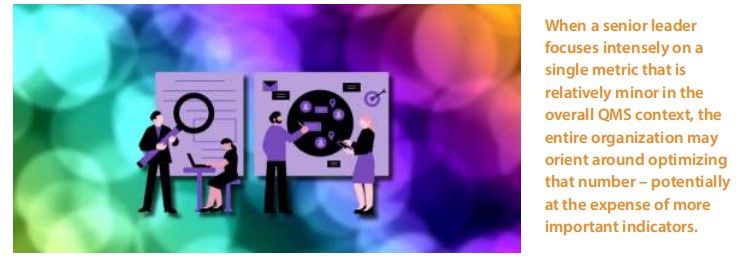
Similarly, when a senior leader focuses intensely on a single metric that is relatively minor in the overall QMS context, the entire organization may orient around optimizing that number – potentially at the expense of more important indicators.

To counter this:

  1. Be clear about QMS purpose and strategy – what the organization is trying to achieve and what “good” looks like.
  2. Design a balanced set of lead and lag indicators.
  3. Avoid metrics that focus solely on speed without measuring quality of output.

Lead indicators might include the quality and timeliness of deviations, engagement levels in training, or the robustness of risk assessments. Lag indicators could include right-first-time rates, on-time-in-full (OTIF) performance, or audit findings.

Time-based targets (such as requiring deviations to be closed within a set number of days) can be useful, but only if paired with measures of thoroughness and effectiveness – so that speed does not undermine substance.

Tools like SIPOC (Suppliers, Inputs, Process, Outputs, Customers) help map end-to-end processes, identify key handovers, and decide where to place lead and lag measures.

Recognizing Strong and Weak Cultures: An Auditor's Perspective

From an auditor’s perspective, there are concrete signs of both strong and weak quality cultures.

Red Flags

  • Auditors being isolated in an office and interacting only with senior leaders.
  • Overly choreographed tours where only selected areas and pre-prepared documents are shown.
  • Staff who appear anxious, unavailable, or “on holiday” during audits.
  • Visible housekeeping issues on the shop floor – rubbish left lying around with no one intervening.

These conditions suggest that the organization may have spent weeks or months preparing for the audit, rather than being genuinely “audit ready” day to day.

Positive Indicators

  • Being casually introduced to new staff who have joined recently but are confident explaining their work.
  • Having a range of people from different levels and departments participate in audit discussions.
  • Teams that are open about known issues, with existing risk assessments, root cause analyses, and CAPA plans available without special preparation.

In such environments, audits become a natural reflection of everyday practice rather than a special performance.

Looking Ahead: Regulatory Evolution and Digital Transformation

Quality culture is becoming a more visible topic from both regulatory and standards perspectives. ISO 9001 is being revised, with draft versions indicating greater emphasis on quality culture – though the auditing approach is still to be defined.

On digital transformation and AI, technology should be viewed as a set of tools that can accelerate the early stages of work – drafting, data gathering – but human judgement, risk assessment, and final decision-making must remain central. If organizations simply hand decisions over to AI or allow digital tools to further reduce human interaction, quality culture will likely suffer.

Technology has made it easier to send messages but, in many cases, harder to build real connection and trust.

Advice for Emerging Quality Professionals

For junior quality professionals working under leaders who are not strongly engaged with culture, the advice is to stay aligned with personal values. Compromising those values just to conform risks disengagement and simply “ticking boxes.”

Instead, emerging professionals should aim to be “the leader they don’t have”: completing risk assessments properly, working collaboratively with colleagues, and building small positive “subcultures” with like-minded peers.

Using a microbiological analogy, culture is like growth on an agar plate: it can start with one person, spread to a small group, then to a department, and eventually influence the wider organization – especially when leadership changes create openings for new ways of working.

Conclusion

Quality culture is not a slogan or a checklist; it is an ongoing, organization-wide journey. It manifests in how people behave when leaders are absent, how mistakes are handled, how metrics are designed, how communication flows, and how widely accountability is shared.

By focusing on purpose, people, process, and performance; by shifting from policing to partnership; and by using tools and technology to enhance rather than replace human judgement and connection, life sciences organizations can build a culture where quality is truly part of everyday work – especially when no one is watching.

This article is based on a conversation featured on the Pharma Conversations podcast.