

Flexible and efficient production of oral solid dosage forms
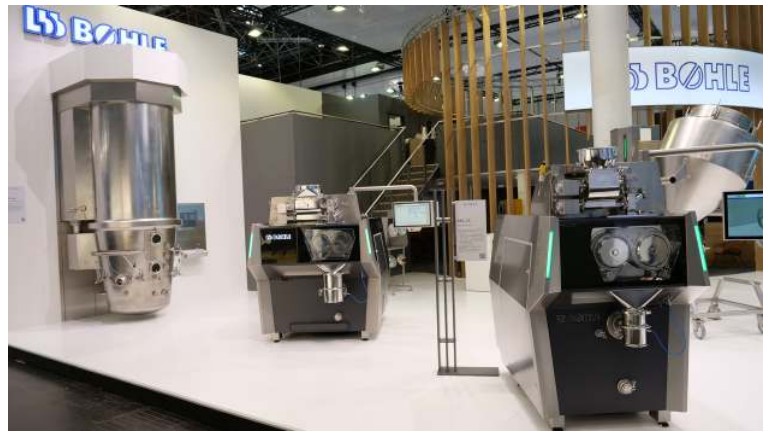
Dry granulation, also known as roller compaction, is a well-established and widely used technology in the manufacture of solid oral dosage forms. Compared to wet granulation, dry granulation offers significant advantages, particularly for moisture- and heat-sensitive active pharmaceutical ingredients (APIs). The process does not require granulation liquids, drying steps or solvent recovery, making it highly energy-efficient and cost-effective in modern pharmaceutical production.
The aim of granulation is to convert fine powders into coarse agglomerates that have improved flowability, reduced dust formation and enhanced compressibility. During roller compaction, a powder blend consisting of APIs and excipients is compacted between two counter-rotating rollers to form ribbons or flakes. These flakes are then milled and sieved to produce granules with a defined particle size distribution. Compared to the starting material, the resulting compacted granules have a higher bulk density and improved handling characteristics, which supports the production of uniform tablets.
Dry granulation is used in various industries, including pharmaceuticals, nutraceuticals, food processing, chemicals, and agriculture. In the pharmaceutical industry, it is commonly used to produce tablets, capsules, effervescent dosage forms and highly potent formulations. Dry granulation is also increasingly selected during early product development due to its suitability for continuous manufacturing concepts.
Process Technology and Roller Compaction Design
The mechanical design of roller compactors differs, particularly in the arrangement of the compaction rollers. Systems with horizontal, vertical or inclined rollers are available. Horizontal roller arrangements offer significant process advantages, as the screws are more effectively ventilated and the flakes are discharged over shorter distances. Furthermore, modern dry granulators utilise variable roll gaps instead of fixed ones. Continuous gap measurement combined with automated control loops ensures the roll gaps remain parallel throughout the process, resulting in flakes of consistent thickness and porosity. The screw speed is automatically linked to the gap adjustment, enabling stable and controlled feeding of the material.
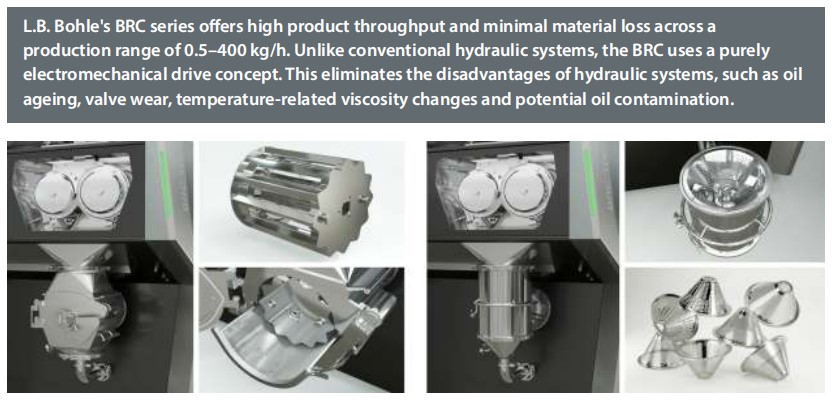
L.B. Bohle’s BRC series offers high product throughput and minimal material loss across a production range of 0.5–400 kg/h. Unlike conventional hydraulic systems, the BRC uses a purely electromechanical drive concept. This eliminates the disadvantages of hydraulic systems, such as oil ageing, valve wear, temperature-related viscosity changes and potential oil contamination. Integrated force-measuring sensors directly monitor the compaction force to ensure highly precise and reproducible process control.
The final particle size distribution of the granules is significantly affected by the milling and sieving steps. L.B. Bohle uses the Bohle Turbo Sieve Mill (BTS), which has interchangeable sieve inserts, to gently and precisely reduce the size of the granules, even at high throughputs. The system can also be quickly converted to a Bohle Rotary Sieve (BRS) to allow flexible adaptation to specific process and product requirements.
Hygienic Design, Containment and Operational Efficiency
In addition to process efficiency, critical factors in pharmaceutical production include hygienic design and ease of operation. BRC systems are designed according to GMP requirements and are equipped with integrated WIP (Washing-in-Place) systems for residue-free cleaning. Tool-less assembly and disassembly significantly reduce changeover times. According to operational data, cleaning and reassembly can be completed in around 30 minutes, whereas conventional systems may require several hours.
Another important aspect of modern pharmaceutical production is containment. The increasing potency of APIs, particularly in oncology applications, necessitates highly sophisticated containment concepts to protect operators and prevent product contamination. Special dry granulation systems for containment levels up to OEB 5 include integrated isolators, glove box systems, vacuum monitoring and dedicated containment ports for sample handling and product discharge. Integrated WIP systems also support residue-free cleaning procedures safely.
Dry granulation has therefore become a highly efficient, flexible and sustainable technology for modern pharmaceutical manufacturing. The fact that it is suitable for continuous processing, has low energy consumption, is designed to be compact, and is compatible with containment applications makes roller compaction an increasingly important solution for producing oral solid dosage forms.
This article is contributed by L.B. Bohle (Ennigerloh, Germany).