

Pharma Machines & Technology

From Powder to Predictability

Using USP <1062> to Make Better
Formulation Decisions

Understanding tabletability, compressibility, and compactibility can help formulation scientists reduce trial and error, better understand material behavior, and identify potential scale-up challenges earlier in development.

For formulation scientists, developing a tablet is rarely as simple as determining whether a powder can be compressed into a solid dose. The more important questions come next.

How will the formulation respond as compression pressure changes? How readily will the material densify? Will it develop sufficient tensile strength? And will the behavior observed during development provide the understanding needed to move confidently toward production?

Answering these questions requires more than producing tablets and measuring their physical properties afterward. It requires understanding the relationships among the formulation, the compression process, and the resulting tablet.

USP General Chapter <1062>, Tablet Compression Characterization, provides a framework for developing that understanding. Its methodologies allow researchers to characterize compression behavior by examining how critical properties change in relation to one another. In doing so, scientists can move beyond determining whether a formulation produces an acceptable tablet and begin understanding what’s needed to apply QbD (Quality by Design) to critical process parameters.
Moving Beyond "Can It Make a Tablet?"

Hardness, thickness, weight, appearance, and friability are familiar and important measurements in tablet development. But they primarily describe the tablet produced under a particular set of conditions.

USP <1062> takes the investigation deeper by examining relationships among compression pressure, solid fraction, and tensile strength. Three concepts are central to that characterization: compressibility, compactibility, and tabletability.

Each provides a different view of what happens as powder becomes a tablet. Together, they provide a more complete picture of how a formulation responds to compression.

Compressibility: How Does the Material Densify?

Before compression, a powder bed consists of particles, void spaces, and air. As pressure is applied, particles rearrange, air is displaced, and the material consolidates.

Compressibility describes this densification behavior.

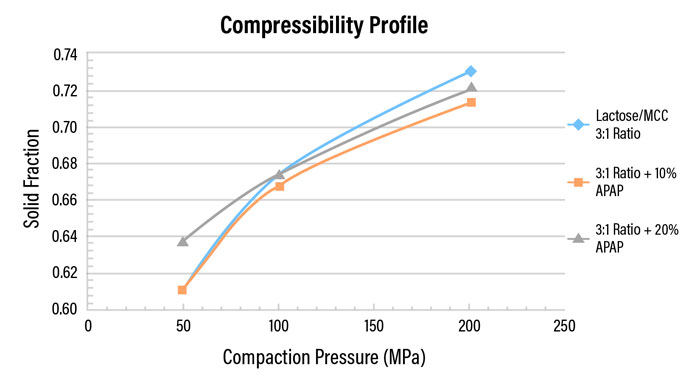
A key measurement is solid fraction, the ratio of tablet density to the material’s true density. Porosity describes the corresponding void space remaining within the tablet.  Solid fraction, being the complement of porosity (Solid Fraction = 1 – Porosity), directly influences disintegration with lower solid fractions leading to faster disintegration.  

By evaluating solid fraction as a function of compression pressure, scientists can determine how readily a formulation densifies as pressure increases.

This matters because similar finished-tablet properties do not necessarily indicate similar compression behavior. Two formulations may ultimately produce tablets with comparable strength while reaching that result through different degrees of densification.

Compactibility: How Effectively Does the Material Develop Strength?

Densification is only part of tablet formation. As particles consolidate, they must also form sufficient interparticulate bonds for the compact to maintain its integrity.

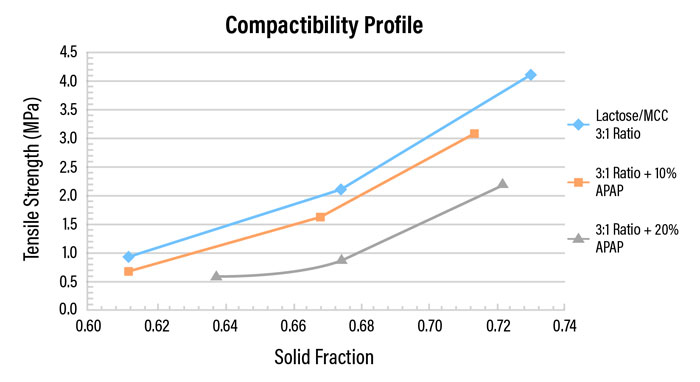
Compactibility describes the relationship between tensile strength and solid fraction.

Consider two formulations compressed to a similar solid fraction. If one produces substantially greater tensile strength, the difference cannot be explained by densification alone. The formulations are exhibiting different bonding behavior.

That distinction can be particularly useful when comparing formulation variables such as excipients, API concentrations, or processing approaches. Instead of knowing only that one formulation produced a stronger tablet, the scientist gains insight into how efficiently strength developed as the material consolidated.

Tabletability: How Does Compression Pressure Translate into Tablet Strength?

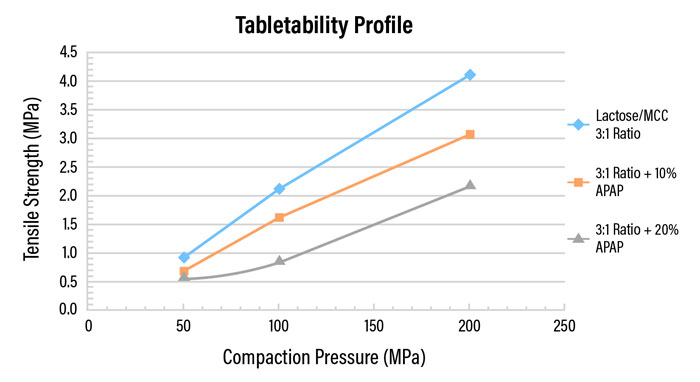
Tabletability describes the relationship between tensile strength and compression pressure.

Rather than evaluating a formulation at a single compression setting, researchers can observe how tensile strength develops across a range of compression pressures.

The resulting profile provides considerably more information than an isolated hardness or tensile-strength measurement. It can reveal differences between formulations that may not be apparent when tablets are evaluated at only one operating condition and identify behavior that warrants further investigation before scale-up.

Three Relationships, One More Complete Picture

The real value becomes apparent when tabletability, compressibility, and compactibility are considered together.

A compressibility profile shows how the formulation densifies as compression pressure increases.

A compactibility profile shows how tensile strength develops as the material reaches different solid fractions. Typically, higher solid fractions provide higher tensile strength (up to the elastic limit of the formulation).

A tabletability profile shows how tensile strength changes as compression pressure increases. The graph’s plateau indicates maximum applied pressure ranges that is essential in the prevention of capping.

Compression characterization profiles allow researchers to evaluate relationships among compression pressure, solid fraction, and tensile strength rather than relying solely on isolated tablet measurements.
  • The distinction is fundamental.
  • A hardness result is a data point. A tabletability profile is a relationship.
  • A solid-fraction measurement is a data point. A compressibility profile shows how that property changes as compression conditions change.
  • Individual measurements describe what happened under a particular condition. Relationships provide greater insight into why the formulation behaved as it did.

Why This Matters Before Scale-Up

Ultimately, the formulation developed in R&D must move beyond the laboratory.

That transition introduces conditions that can differ significantly from those encountered during early development. A multi-station production tablet press operates continuously through die filling, compression, decompression, and ejection. Machine speed influences dwell time and the time available for the formulation to respond during compression.  USP <1062> provides measurement of SRS (Strain Rate Sensitivity).  

A formulation that produces an acceptable tablet during a laboratory trial therefore still needs to be understood as a material system.

USP <1062> characterization can help establish that understanding before greater quantities of material and additional development resources are committed downstream.  The methods used serve as a measurement framework within QbD to establish process parameters for compaction pressure, press speed, tablet tensile strength, and more.

The goal is not to predict every condition that will occur during production, nor does compression characterization eliminate the need for scale-up trials. Instead, it provides a more informed basis for those trials.

The question changes from:

“Did we make an acceptable tablet?”

to

“What does the formulation’s compression behavior tell us about the conditions under which that tablet was produced?”

That is a much more useful question when development is moving toward scale-up.

Understanding the Compression Cycle

Tablet formation is not a single application of force. It progresses through particle rearrangement, compression, decompression, and ejection.

Throughout that cycle, the formulation undergoes changes in particle arrangement, densification, bonding, and elastic recovery. Understanding those responses is important because peak compression force alone provides an incomplete picture of tablet formation. The resulting tablet reflects the material’s behavior throughout the compression event.

Turning Compression Data into Development Knowledge

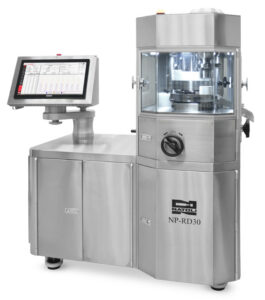
Modern instrumented R&D tablet presses and data-acquisition systems can generate extensive information about individual compression events.

But generating more data is not the objective.

The objective is connecting the data in ways that improve formulation decisions.

Compression pressure can be related to tensile strength. Compression pressure can be related to solid fraction. Solid fraction can be related to tensile strength. Those relationships can then be compared across formulations and development variables.

Imagine two candidate formulations that produce tablets with similar tensile strength under a particular compression condition. Based solely on the finished tablets, the formulations might appear comparable.

Their USP <1062> profiles, however, could reveal substantially different behavior.

One formulation may densify more readily. Another may develop greater tensile strength at a comparable solid fraction. Their finished tablets may look similar, but the mechanisms by which those tablets developed strength are not necessarily the same.

Instead of asking:

“Which formulation made the harder tablet?”

the researcher can ask:

“Did the formulation develop strength because it densified more readily, because it developed stronger interparticulate bonding, or because of a combination of both?”

That is the transition from measurement to understanding.

From Troubleshooting to Understanding

The same approach can be useful when development does not proceed as expected.

Consider capping.

One response is to change formulation ingredients or press settings until acceptable tablets are produced. That may resolve the immediate problem, but it does not necessarily explain why the formulation failed in the first place.

Compression characterization provides a way to investigate the material behavior behind the failure. By examining how a formulation densifies, develops tensile strength, and responds as compression conditions change, researchers can look for behavior associated with the problem rather than relying exclusively on iterative adjustments.

The objective is not to eliminate experimentation. It is to make experimentation more informative.

Building Knowledge That Can Move with the Formulation

A successful R&D formulation should do more than produce acceptable tablets under controlled laboratory conditions. Development should also create knowledge that can support the formulation as it moves downstream.

Compression characterization can help researchers investigate whether changing an excipient alters strength development, whether a formulation requires increasing compression pressure to achieve the desired tensile strength, or whether different formulations reach similar finished-tablet properties through fundamentally different compression behavior.

That information can provide additional context for formulation selection, process development, troubleshooting, and subsequent scale-up work.
Trial work will always remain an essential part of pharmaceutical R&D. USP <1062> does not eliminate experimentation, and compression characterization cannot predict every challenge that may emerge during scale-up.

What it can do is make those experiments more informative.

Instead of asking only whether a formulation worked, scientists can ask why it worked, how it responded as conditions changed, and what those relationships reveal about its behavior.

The objective is not simply to generate more compression data. It is to make better decisions from the data being generated.

By providing a framework for relating compression pressure, solid fraction, and tensile strength, USP <1062> can help R&D scientists transform individual measurements into a more complete understanding of formulation behavior—and carry that knowledge forward as development progresses from powder to production.

This article is contributed by Natoli Engineering Company, Inc.