
Pharma Machines & Technology

From Risk Management to Risk Resilience

Why Indian Pharma Needs a 360° Enterprise Risk Management Framework

By Gurmeet Singh

Enterprise Risk Management (ERM) has become important because the risk landscape has undergone a major change, from being merely financial and operational to having different dimensions in an environment that is interlinked across the entire supply chain and all businesses, including pharma. This is particularly relevant for Indian pharma, which operates in a highly regulated, globally connected, and volatile environment due to geopolitical challenges.
The Indian pharmaceutical industry has travelled a remarkable journey since Independence. Initially, India depended heavily on developed countries, particularly the West, for its medicines. A major turning point came in 1961 with the establishment of Indian Drugs and Pharmaceuticals Limited (IDPL), a public-sector undertaking created with Soviet collaboration to promote self-sufficiency in essential medicines and affordable healthcare.

(IDPL’s bulk-drug operations ceased in 1996, while its main manufacturing operations ended in 2003).

Until 2005, India’s pharmaceutical industry largely operated without product patents. With India becoming TRIPS-compliant in 2005 and introducing pharmaceutical product patents, a significant window of opportunity emerged. The industry utilised this period effectively, particularly between 1995 and 2005, witnessing rapid growth and the emergence of numerous pharmaceutical companies, especially in Andhra Pradesh, Gujarat, Maharashtra and other States.

Indian Pharma has changed substantially and so has the RISKS

The rapid growth of the Indian pharma industry witnessed the advent of various rules, regulations, regulatory processes, and the need for Standard Operating Procedures and quality management, as Indian pharma was taking steps to serve not only the needs of the domestic market but also, gradually, to provide affordable medicines for critical diseases like AIDS and others. India was emerging as the pharmacy to the world. When the world is your oyster, that brings with it various risks associated with operating across geographies, ranging from less regulated to highly regulated markets.

Department Risk to Enterprise Risk Management

The graduation from departmental risk to company-wide risk. Risks that were earlier confined to a particular department are no longer compartmentalized but spill over into other departments across the organization. It will be good to define the term RISK and in simple words, it is as under:

It is UNCERTAINTY about the future that can affect the achievement of our Objectives and may result in undesired outcome with a potential loss.

Enterprise Risk Management (ERM) may be defined as a holistic company-wide framework used by an organisation to identify, assess, manage and monitor all types of risks. ERM has become important because the risk landscape has undergone a major change, from being merely financial and operational to having different dimensions in an environment that is interlinked across the entire supply chain and all businesses, including pharma. This is particularly relevant for Indian pharma, which operates in a highly regulated, globally connected, and volatile environment due to geopolitical challenges.

The industry being so very complex in its processes, ERM is no longer merely a compliance requirement for Indian pharma, but is becoming a strategic imperative. The industry is moving from managing isolated risks in silos to a highly connected system, from one end to another, extending to the last bit of the supply chain, to the last mile, and the right administration of the drug product to the patient at the desired intervals, with the importance of maintaining product integrity throughout. We have all noticed the importance of the cold chain in the case of perishables such as temperature-sensitive injections and vaccines. No industry as such can have silos working independently, as the actions of one department impact another, and there can be a chain reaction if any wrong action takes place, and the results may be disastrous.
Importance of Digitalisation and Transformation

Human intervention is being reduced, and all actions on the line are being captured through the advent of mechanization and digital transformation, resulting in the tracking and tracing of events at each and every step. The implementation of SAP, ERP, LIMS, and other pharma-related digital tools such as e-Logbooks and e-BMRs is being extensively used to map all processes and enable real-time monitoring and audit trails, as desired by the regulatory authorities.

Enterprise Risk Management: A Strategic Imperative

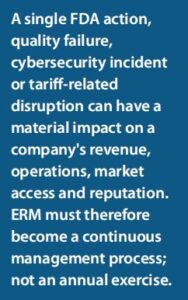
The Indian pharmaceutical industry operates in a highly interconnected global environment, exposed to complex regulatory, geopolitical, supply-chain and technological risks that can escalate rapidly. A single FDA action, quality failure, cybersecurity incident or tariff-related disruption can have a material impact on a company’s revenue, operations, market access and reputation.

ERM must therefore become a continuous management process; not an annual exercise.

From Risk Identification to Risk Resilience

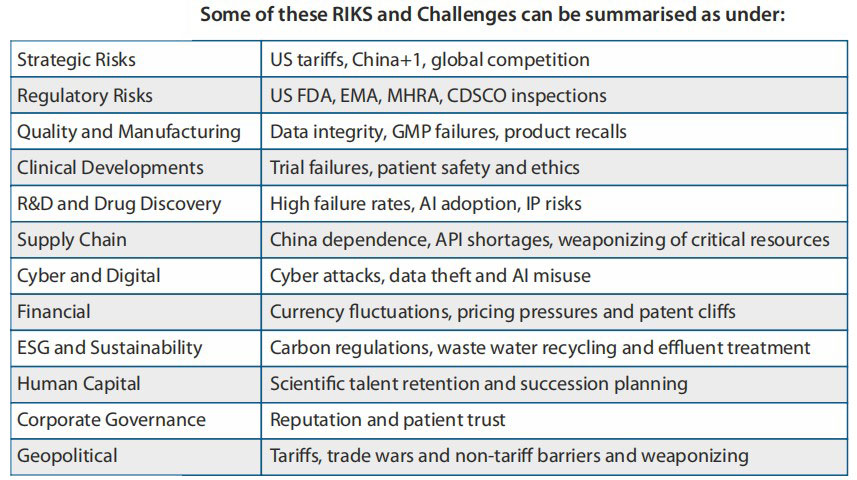
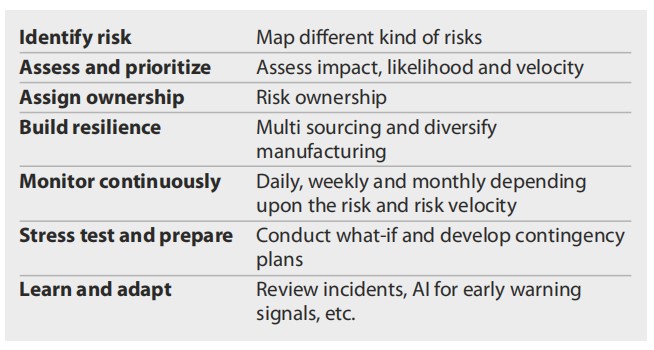
There is a need for a pharmaceutical company based on its SWOT analysis to identify and make a road map as to how the company is going to address the risk factors, its likely impact and mitigate the adverse impacts of the same. The same may be elaborated as below:

The objective of ERM is not to eliminate risk. It is to ensure that the company understands its risks, prepares for them and takes informed risks without threatening the organisation’s long-term resilience.

Strategic Risk Management Group

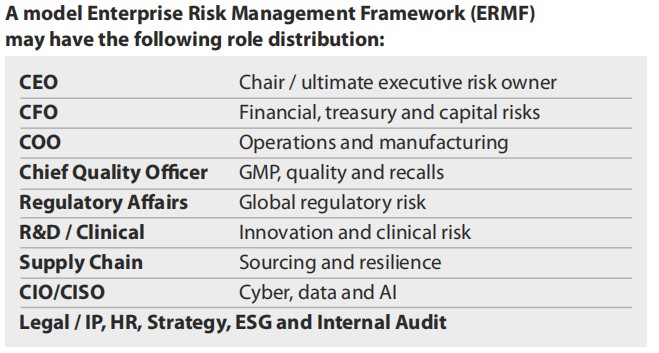
Every pharmaceutical company should consider establishing a dedicated Risk Management Group, which could be termed a Strategic Risk Management Group (SRMG). The terminology and organisational structure may vary from one organisation to another, depending on its size, complexity and risk profile.

A suggested framework could clearly define the roles and responsibilities of such a group. However, risk management cannot be the sole responsibility of this function. It must be an organisation-wide responsibility, embedded across all levels and functions.

Since pharmaceutical companies operate within an interconnected ecosystem, effective risk management must extend beyond the organisation to include suppliers, manufacturers, logistics providers, CDMOs/CMOs, distributors and other strategic partners. Building resilience requires the entire ecosystem to identify, assess, monitor and proactively manage risks.

To develop an effective Enterprise Risk Management Framework, it is important to consider organizational strengths and weaknesses, enabling a tailored approach that suits the specific needs of each pharmaceutical company.

ABOUT THE AUTHOR

Gurmeet Singh brings over three decades of global pharmaceutical leadership with expertise in supply chain, sourcing, procurement, and strategic partnerships. His career spans senior roles at Ranbaxy, Wockhardt, Orchid Pharma, Midas Pharma GmbH, Alfa Pharma GmbH, and DNDi, where he successfully built resilient supply chains and expanded markets across LATAM, North America, and Europe.

At AppChem, Gurmeet drives sourcing, procurement, and business development, focusing on APIs, intermediates, and formulations. He leads global supplier networks, forges strategic alliances, and expands AppChem’s presence in key international markets, ensuring quality, compliance, and competitive advantage for partners worldwide.

He holds a management degree from BITS Pilani and a law degree from Delhi University, along with certifications in Corporate Governance, Independent Directorship, Risk Management, and Intellectual Property Rights Law from IICA, IIFT and National Law School of India University, Bangalore.