

 Tablet coating is a pivotal step in the production of oral solid dosage (OSD) forms, influencing product protection, patient acceptance, and drug release. For India’s pharmaceutical industry, the world’s largest supplier of generic medicines, coating technology must deliver not only consistent quality but also flexibility, cost-efficiency, and seamless integration with existing production systems. Semi-continuous coating emerges as a compelling solution, bridging the gap between traditional batch processing and fully continuous manufacturing.
Uniform coating begins with the movement of the tablet cores. The tablets must pass through the spray zone in a consistent and controlled manner, while excessive mechanical stress must be avoided. If the tablet bed is moved too aggressively, tablet breakage, edge damage or twin formation may occur.
An elongated coating drum with a length-to-diameter ratio greater than one can support a large and well-defined spray zone. Helical mixing spirals provide continuous and gentle movement of the tablet bed, promoting homogeneous distribution of the cores under the spray nozzles. A relatively shallow tablet bed can also reduce the mass pressure within the bed. When the tablets are guided through the drum rather than strongly accelerated, mechanical stress can be reduced.
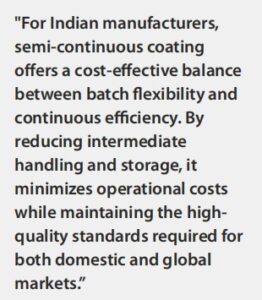 The spray system is equally important. Relevant variables include the type and number of nozzles, nozzle spacing, the distance between the nozzles and the tablet bed, spray angle, atomization pressure and suspension supply. These parameters must be selected in relation to the formulation, tablet geometry, batch size and desired coating weight gain.
The design of the air-handling system influences both drying performance and coating quality. Process air should enter the tablet bed in a controlled and calm manner, providing efficient energy and mass transfer directly where drying is required. If the air stream passes directly across the spray nozzles, it may cool or disturb the spray pattern and increase the risk of spray drying. Spray-dried particles can reduce coating efficiency and may accumulate on the equipment, spray nozzles or air ducts.
An airflow design in which process air enters and exits through the tablet bed can help minimize these effects. It supports direct drying of the applied suspension while creating a more stable spray environment. The result is a reduced risk of premature drying and improved coating uniformity.
Industrial coating processes must manage several challenges at the same time. The equipment must accommodate different products and batch sizes without compromising process control. It must also support cleaning, safe operation, data management and reliable production over extended periods.
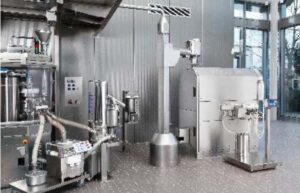 Long process times may become a significant limitation when formulations require several coating layers or when production schedules involve multiple products. Conventional batch coaters may also require the tablet cores to be collected, stored and scheduled for coating at a later stage. This can increase handling requirements, storage needs and overall lead time.
Cleaning is another important consideration. Deposits on the coating drum, spray nozzles or air ducts may affect process performance and require additional interventions. In repetitive operation, frequent manual cleaning between cycles would reduce productivity. Equipment design must therefore consider resistance to soiling, nozzle protection and the prevention of spray-dried deposits.
Modern coating systems may address these requirements through automated recipe management, process monitoring, long-term data storage and interfaces to external systems. Automated sampling, closed-door loading and discharge, hygienic machine design and energy monitoring can further support safe and controlled operation. Rapid, complete discharge and automated cleaning are also relevant for manufacturers producing multiple products or operating under demanding production schedules.
The three principal process concepts differ in how tablet cores enter, pass through and leave the coating operation.
In batch coating, a defined quantity of tablet cores is loaded into the coating drum. The entire batch remains in the process until the coating cycle is completed. The coated tablets are then discharged before the next batch is introduced. Batch coating offers a familiar and flexible operating concept, particularly for products manufactured in different quantities or according to varied recipes.
In a continuous coating process, tablet cores enter the process at a constant flow rate, pass through the coating equipment and leave continuously as coated tablets. However, the behaviour of individual tablet cores as they move through the process must be sufficiently controlled. If the residence times vary widely, individual tablets may experience different exposure times in the spray zone. This can be particularly critical for functional coatings, where variations in exposure can lead to insufficient coating uniformity.
 Semi-continuous coating uses repeated, defined coating cycles. A measured quantity of tablet cores is fed into the coating drum, processed according to a defined recipe and discharged before the next quantity is introduced. In this way, the process can operate repetitively with a continuous overall throughput while maintaining a controlled and comparable residence time for each group of tablet cores.
The semi-continuous approach therefore combines elements of both concepts. It retains the defined process conditions of a batch cycle while enabling automated, repetitive operation and direct integration with upstream tableting.
 “For Indian manufacturers, semi-continuous coating offers a cost-effective balance between batch flexibility and continuous efficiency. By reducing intermediate handling and storage, it minimizes operational costs while maintaining the high-quality standards required for both domestic and global markets.”
Semi-continuous coating systems can also support compliance with stringent regulatory requirements, such as those set by the CDSCO in India, as well as international standards like WHO-GMP or ICH guidelines. Automated data logging, process monitoring, and reproducible batch conditions facilitate auditability and process validation, which are critical for export-oriented manufacturers in India.
- Feeding:A defined quantity of tablet cores is introduced through the product inlet.
- Tablet-bed warm-up:The bed is conditioned, commonly using exhaust temperature as a target parameter.
- Spraying:The coating suspension is applied while drying air remains active. Depending on the product, the spray profile may include different spray rates.
- Drying:The coated tablets remain in the drum until the required drying stage is completed.
- Tablet-bed cool-down:The product is cooled under controlled conditions.
- Discharging:The coated tablets leave through the product discharge port.
 After discharge, the next quantity of tablet cores can be introduced and the cycle repeated. A bypass valve can keep the process air active during the transition between cycles, supporting a rapid continuation of operation.
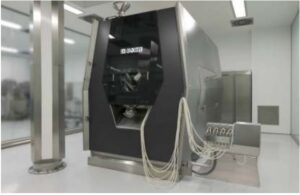
L.B. Bohle´s KOCO 25 is described as a semi-continuous film coater based on an elongated drum design with helical mixing spirals. The spirals support homogeneous distribution of the tablet cores through the spray zone. The spray arm provides automatic adjustment of spray angle and distance and carries six two-substance spray nozzles. The spray system includes recirculation and individual nozzle supply to support reliable and homogeneous application of the coating suspension.
An in-line Raman spectroscopy probe can be integrated into the coating drum for process analytical technology applications. Raman spectroscopy may be used to monitor the process and determine the coating endpoint, supporting enhanced process control.
For pharmaceutical manufacturers in India, the semi-continuous approach can be considered in several production scenarios. It may support high-volume products manufactured over several hours at a relatively constant throughput. It can also provide a practical link between established batch production and more integrated continuous manufacturing concepts.
 The technology may be relevant where manufacturers need to manage multiple products, reduce intermediate storage and handling, or improve the connection between tableting and coating. Its defined residence time can be advantageous when coating uniformity is especially important, while its repetitive operation can support productivity and consistent process execution.
At the same time, semi-continuous coating should not be viewed as a universal replacement for batch coating. Product characteristics, coating formulation, required release profile, tablet strength, production scale, cleaning strategy and plant integration must all be assessed during process development and equipment selection.