



Pharma Machines & Technology

Sharks don't fly

&

Eagles don't swim

Most organizations actively protect and develop their core competencies. For example, pharmaceutical manufacturers focus on producing safe, high-quality medicines, which is essential to their reputation and license to operate. (Report on the State of Pharmaceutical Quality, 2024). Machine manufacturers similarly rely on engineering precision and manufacturing reliability. (Datanomix, 2022). These skills are systematically built and refined. However, many organizations do not apply the same discipline to training and developing internal capabilities. (Antonioli et al., 2026). This raises an important question that bridges core organizational priorities with learning practices, those that are considered good to have but not really a must to have? Are there consequences when organizations do not treat training with the same strategic intent as other core competencies for businesses?

The Curious Case of the “Accidental Trainer”

In many organizations, the logic goes something like this:

  • “You have 10 years of experience operating the machine – so you can train others.”
  • “You know the SOP well – why don’t you conduct the session?”
  • “You handled that deviation – please explain it to the team.”

If work experience alone qualified someone to teach, the industry would look very different. Performing a task is not the same as imparting knowledge. Effective teaching requires understanding adult learning, structuring information, building clarity, designing practice and feedback, and accurately measuring competence. (Teaching quality and teachers’ professional competences – their measurement, relevance, and association in adult education, 2025, pp. 1-20)

To build effective training systems, organizations must establish clear, actionable criteria for selecting and developing trainers. Trainers are to be chosen for both technical proficiency and communication skills to ensure they can clearly explain complex concepts. Specific selection criteria may include: demonstrated subject-matter expertise, observation of work practices, peer recommendations, and assessment of communication abilities, such as clarity, listening, and the ability to provide constructive feedback. Organizations might use structured rubrics or targeted interview questions to assess potential trainers, such as “Can you describe a time you explained a complex task to a colleague? What approach did you use?” or “How would you adjust your teaching for someone struggling with a particular concept?” By making the trainer selection process transparent and consistent, leaders can operationalize high standards for capability development, where the most precious resources are handled with as much seriousness as is a batch that is manufactured for the market.

All trainers should have received foundational training in adult learning principles. This includes recognizing different learning styles, using practical examples, and encouraging participation. (Framework for industry engagement and quality principles for industry-provided medical education in Europe, 2017, pp. 3-8). Each training session ought to have clear objectives, such as:

a) A logical structure, and opportunities for practice and feedback.

b) Provisions for resources and ongoing development, such as coaching or peer observation, to refine teaching methods.

c) Access to practical tools such as to include lesson plan templates, checklists, mentorships (pairing new and experienced trainers), and external training audits, for structured feedback forms for actionable input.

These tools support continuous improvement, ongoing assessments and consistent growth, much like the other processes adopted within a manufacturing organization.Using objective methods to assess trainer effectiveness, such as collecting participant feedback and regularly auditing training outcomes (Evaluating Training Effectiveness: Methods and Principles, 2021) consistently organizations can elevate training from a routine task to a strategic driver of capability. (Enhancing organisational innovation capability – A practice-oriented insight for pharmaceutical companies, 2022)

Training is a professional discipline, yet many organizations treat it as a secondary or even tertiary activity.

When the Core of the infrastructure and machine Is Protected, but Capability building Is Casual

Imagine a pharmaceutical manufacturer applying the same logic as applied to training to its production floor:

  • “You understand medicines – so you can design the plant.”
  • “You worked in QA – so you can run the sterile filling line.”
  • “You know the machine – so you can design its engineering tolerances.”

Would the head of Quality or Operations accept this approach? According to an article by Yvonne Duckworth and colleagues, while companies methodically design, validate, and control processes that impact product quality, many organizations still take an ad hoc approach to developing the human capabilities critical to achieving and sustaining quality.

This lack of oversight is often how people and processes, with specific reference to in-house TRAINING capabilities become organizational orphans.

The Hidden Cost of Weak Training Systems

When training is not treated as a core capability, organizations gradually accumulate hidden losses:

  1. Knowledge Decay
    Critical expertise remains trapped in individuals rather than being systematically transferred. (Duckworth et al., 2025, pp. 12-19)
  2. Procedural Learning without Understanding
    Employees learn what to do but rarely understand why it matters, resulting in weak compliance. (Why Is GMP Training Often the Weakest Link in Manufacturing Compliance, 2025)
  3. Investigation Fatigue
    Many recurring deviations and errors result not from negligence but from incomplete learning. (Smolarek, 2025)
  4. Fragile Operations

So many operations may appear robust on paper but fail under pressure when human capability is not fully developed (Pinaud& Hernandez, 2024) or if not built from the required depth.

Ironically, the human element is often the most complex part of any system, yet it is the least deliberately engineered. (Paul M. Salmonet al., 2022)

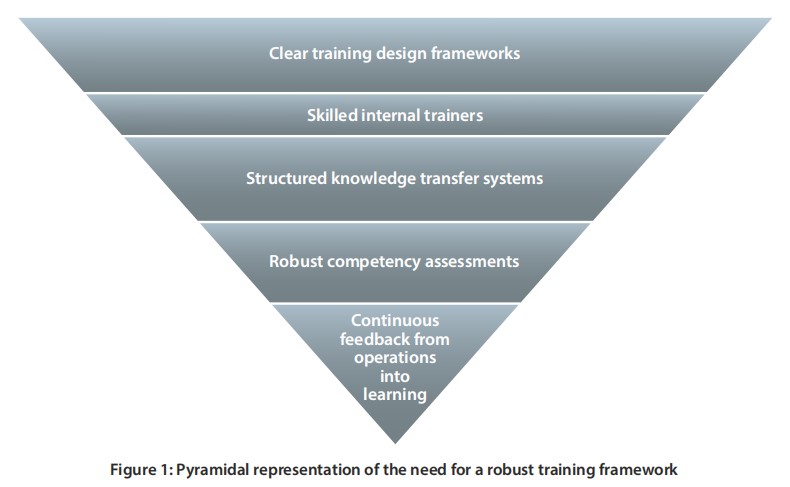
Recognizing these hidden costs creates a natural inflection point: organizations should reconsider their approach to training. Training is not simply an event or a checklist; it must be treated as a capability architecture. begin making this shift, leaders can start with a few practical first actions: conduct an audit of current training effectiveness to identify gaps and strengths; appoint dedicated training leads or champions responsible for advancing training practices; and develop an initial roadmap for systematically improving trainer selection, curriculum design, and measurement of learning outcomes. Taking these concrete steps helps move capability building from an afterthought to an organizational priority.

Organizations that excel operationally do not treat training as a routine activity. The International Society for Pharmaceutical Engineering states operational excellence requires validated manufacturing and intentionally designed, measured learning processes. If training is an operational activity, then without doubt it needs more rigour than all other processes, because of the variability in the behaviour of resources – people.

The Strategic Shift Organizations Must Make

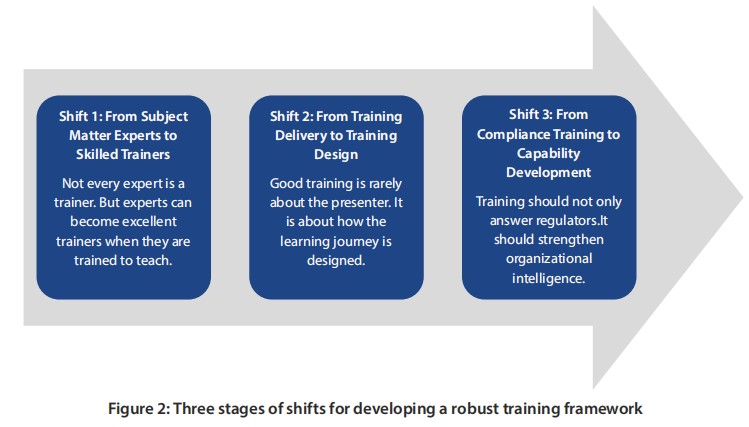
To truly strengthen core competencies, organizations must recognize that capability building is itself a core competency. This requires three shifts.

Process capability and people competency cannot be improved through generic approaches, as both require deliberate engineering. Process capability advances through structured methods such as statistical analysis, repeatability, control strategies, and continuous monitoring. (Movilla-Meza et al., 2025) Similarly, developing people’s competency requires a disciplined framework that goes beyond basic knowledge transfer. (Koehler et al., 2019, pp. 514-520) Organizations should adopt a capability-building approach that integrates clear role-based competencies, structured learning design, supervised practice, real-world simulations, and objective proficiency assessments. According to a case study reported by Attia Hussien Gomaa, implementing lean Six Sigma methods can help organizations improve both their systems and workforce by enhancing product quality, operational effectiveness, and customer satisfaction initiatives. (Sujová&Simanová, 2021, pp. 37-49)

To illustrate this strategic shift, a real-world scenario where a sterile manufacturing facility producing liquid injectables began noticing an increase in particle rejections during visual inspection of filled glass vials. Investigation showed variability across shifts and inspectors.At first glance, the problem appeared to be an inspection issue, but a deeper capability assessment revealed that both process capability and people competency were contributing factors.

The Insight

In sterile manufacturing, process capability eliminates defects at the source, while people capability ensures that any remaining defects are reliably detected before product release. (A framework for process states structural interpretation of zero-defect manufacturing, 2024) Focusing only on inspection skills without addressing upstream process variation was overwhelming for the visual inspectors. Conversely, even the best processes required skilled human detection for ensuring patient safety. (Shardi, 2025). Operational excellence in this manufacturing facility required a dual capability architecture: (Digital Twin–Driven Continuous Process Verification: Securing Data Integrity and Compliance, 2026).

  • Engineering the process to minimize defect creation
  • Engineering human competency to reliably detect and respond to defects

When both evolved together, the system became more resilient, and the number of investigations, batch rejections, and quality risks decreased significantly.

Reclaiming the Orphan

To achieve sustainable operational excellence, organizations must stop treating training as an administrative task. Training is a strategic function. Just as manufacturing excellence depends on process engineering, learning excellence depends on training engineering. Organizations that recognize this early build not only effective systems but also people who understand why those systems work. When people have a deep understanding, processes become integrated and dynamic. Ultimately, the strength of any organization lies not only in its technology, machinery, or SOPs, but in how well it develops the human capability to make them effective every day.

A few questions as we end this conversation:

  • As an operations leader, how intentionally are you building your organization’s capability?
  • What steps will you take this year to elevate training from a routine obligation to a true driver of business performance?
  • Do you treat capability building with the same rigor as your other core competencies?

The question that needs deep thinking is – Is my organization’s core competency in training maximized or is it dithering? Do we have a gold standard for training and its effectiveness as much as our other core systems do?

Just as manufacturing excellence requires Process-first-reengineering, learning excellence requires People-first-training-reengineering. Organizations that recognize this early build something powerful and not just systems that work in isolation, because ultimately, the strength of any organization lies not just in its superior technology, latest machinery, world-class infrastructure or best written SOPs – but is embedded in how well it cultivates the human capability to make them superlative, every single day.

ABOUT THE AUTHORS

Vishal Sharma has a Masters in Microbiology, and is the co-founder of Vienni Training & Consulting LLP and Eduoriens Skill Development LLP. He has played a role in helping many organizations grow and change, scale up, and implement production, monitoring, and validation. He has a body of credible work in the aseptic process and terminal sterilization optimisation in India. With more than 26 years of experience in the biopharmaceutical and allied industries, Vishal is committed to supporting and strengthening the systems approach in microbiology and aseptic areas. Vishal actively volunteers with PDA at the local and global level. He has held various roles in the PDA India Chapter, including serving as President. Currently, he is a member of PDA’s RAQAB and the co-lead of the Quality Systems Interest Group (IG). He volunteered as a task force member for PTCs on “Remote audits and Inspections” and Revision for Technical Report #3, “Validation of Dry Heat Processes Used for Depyrogenation and Sterilization”, and has ongoing contributions in multiple other technical reports. Vishal’s specialties lie in growth, with a deep interest in the impact of learning science on an organization’s process optimization, culture, and the effects of learning ROI in areas such as sterilization, aseptic processing, statistics, and microbiology.

Ivy Louis is the Founder of Vienni Training & Consulting LLP and Eduoriens Skill Development LLP. She holds a Master’s in Pharmaceutical Sciences and an MBA in Human Resource Management, and has 37 years of experience across teaching, pharmaceutical manufacturing, quality, and service industries. Since 2010, she has provided consultation, training, and educational services to pharmaceutical and biopharmaceutical operations, with a focus on manufacturing, quality assurance, and human behavior. Her services are distinguished by innovative approaches to workplace excellence, competency assessment, and performance standards. Ivy has been involved with PDA Inc. since 2003 and the PDA Chapter in India since 2013, which has expanded her expertise. She has served on the Steering Committee for Awards (2017), the PDA Letter Editorial Committee, and the Task Force for developing an ANSI standard on Quality Risk Management for Aseptic Processing. She is a former Board member of PDA Inc. and currently serves as Chair of the Science Advisory Board. Ivy remains passionate about education, learning, and training, driven by the transformative impact of teaching on the quality, integrity, productivity and safety of operations.