

By Amit Malviya
Digital Twin is not merely a static 3D model; it is a dynamic, living replica of a physical system – from a single machine to an entire production line – that evolves in real-time. These virtual models stay “smart” by listening to the digital heartbeat of the physical factory through a sophisticated nervous system of real-time sensors. The digital shift does more than just increase speed; it allows us to address the “sustainability paradox” – the challenge of using energy-intensive AI to ultimately create a more efficient, greener industry. And, the Digital Twin Revolution is no longer a theoretical exercise. Leading companies are currently utilizing AI-integrated QbDD to achieve remarkable results
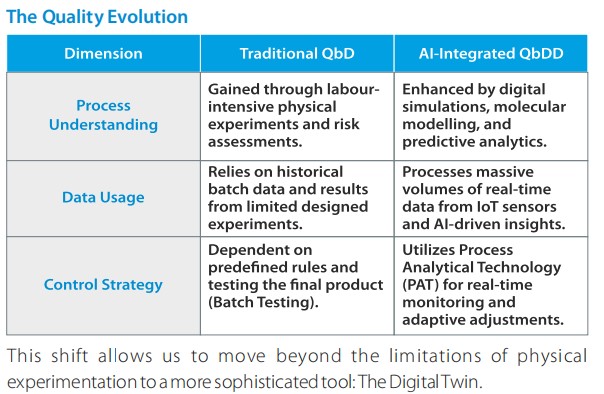
In the traditional landscape of pharmaceutical manufacturing, we relied on Quality by Design (QbD). This science-based approach was a significant step forward, aiming to build quality into the product from the start by defining the Quality Target Product Profile (QTPP) – the essential characteristics that ensure safety and efficacy. However, traditional QbD often remains “manual,” tethered to physical experiments and retrospective batch testing.
As we look toward the future of Industry 4.0, we are transitioning to Quality by Digital Design (QbDD). This evolution moves the laboratory into a virtual environment, using Artificial Intelligence (AI) and high-fidelity simulations to predict outcomes before a single molecule is processed. By shifting from physical trials to digital simulations, we can explore thousands of scenarios instantly, ensuring that we meet Critical Quality Attributes (CQAs) like purity and dissolution rates with unprecedented precision.
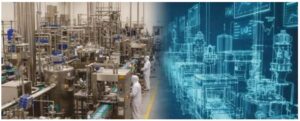
In my role as an innovation lead, I often describe a Digital Twin (DT) as the factory’s “virtual mirror.” It is not merely a static 3D model; it is a dynamic, living replica of a physical system – from a single machine to an entire production line – that evolves in real-time.
“A Digital Twin is a virtual replica of a physical system or process… constantly updated with real-time data from its physical counterpart, allowing for simulation, analysis, and optimization throughout the product’s lifecycle.”
A Digital Twin serves three vital functions in a modern pharmaceutical facility:
Predictive Maintenance: By analyzing historical equipment data, the twin predicts machinery failures before they occur. This reduces unplanned downtime and prevents the loss of expensive batches.
Process Optimization: The twin can simulate “what-if” scenarios for Critical Process Parameters (CPPs) – such as mixing speed, humidity, and reaction kinetics – to find the most efficient manufacturing path without wasting physical raw materials.
Quality Assurance: By continuously monitoring the virtual process, the twin ensures that every batch stays within its “Design Space,” maintaining the consistency required for complex medicines.
These virtual models stay “smart” by listening to the digital heartbeat of the physical factory through a sophisticated nervous system of real-time sensors.
To keep the Digital Twin updated, the factory employs Process Analytical Technology (PAT). Think of PAT as the “eyes and ears” of the system. Advanced sensors, such as Near-Infrared (NIR) and Raman spectroscopy, act as high-tech observers that detect chemical and physical changes at the molecular level during production.
When these sensors detect a deviation from the ideal state, the system initiates an Adaptive Control loop. Instead of a manual shutdown, the AI handles adjustments through a “Sense-Analyze-Adjust” cycle:
This constant, invisible calibration leads to a breakthrough in how we finally test and release medicine to the public.
In a traditional factory, finished medicine sits in a warehouse for days or weeks while scientists perform “Old-Fashioned Batch Testing” in a lab. This delay is not just an efficiency issue; it is a clinical risk. Real-Time Release Testing (RTRT) changes the game by using AI-enhanced continuous testing during production.
RTRT is a critical advancement for Biopharmaceuticals and Narrow Therapeutic Index (NTI) drugs, where even minor deviations in concentration can lead to significant therapeutic failure. The system “knows” the quality is perfect the moment the process ends.
The primary “wins” of RTRT include:
Speed to Market: Accelerated release timelines mean life-saving medicines reach hospitals and patients faster.
Reduced Costs: By eliminating the need for massive storage and repetitive post-production lab work, the cost of manufacturing drops significantly.
This digital shift does more than just increase speed; it allows us to address the “sustainability paradox” – the challenge of using energy-intensive AI to ultimately create a more efficient, greener industry.
The pharmaceutical sector is responsible for a significant environmental footprint, but digital twins and AI are making “Green Manufacturing” a reality. While model training consumes significant computational energy, we mitigate this through “Green Simulations” which reuse previously processed data rather than starting every simulation from scratch, drastically reducing the carbon footprint of R&D.
Sustainability Spotlight:
Energy Efficiency: Industrial projects integrating these digital groups have demonstrated a 15-25% increase in energy efficiency.
Waste Reduction: AI-based quality control can identify defective batches early, reducing material waste by up to 25%.
Emission Control: Advanced analytics in the supply chain significantly lower greenhouse gas emissions by optimizing logistics and reducing overproduction.
These concepts are being successfully deployed by the industry’s most recognizable names to transform how medicine is made.

The Digital Twin Revolution is no longer a theoretical exercise. Leading companies are currently utilizing AI-integrated QbDD to achieve remarkable results:
GSK (GlaxoSmithKline): By employing real-time energy and sensor monitoring, they achieved a 34% reduction in waste generation and identified errors up to 35 days early.
Merck: Launched the AIDDISON™ platform, which integrates virtual molecule design to potentially reduce the design cost of drugs and manufacturing by 70%.
Johnson & Johnson: Their Xi’an facility utilized AI and IoT for a “Smart Supply Chain,” resulting in a 47% drop in material waste, a 26% reduction in greenhouse gas emissions, and a 23% cut in energy use.
The future of pharmaceutical manufacturing requires us to move beyond checking for quality after a product is made. We must embrace the shift to building quality digitally at the molecular level. By creating virtual mirrors of our factories, we ensure that medicine is higher quality, more accessible, and kinder to our planet.
Amit Malviya is Vice President – Quality Assurance at Zest Pharma, and leading the role as a Technical Adviser in the Artificial Intelligence (AI) powered quality compliance and pharma manufacturing automation division at Emorphis Technologies. He has over two decades of experience in the pharmaceutical industry, specializing in manufacturing, quality process improvement, and regulatory affairs. Amit is privileged to lead the quality team, and his thrust for research provides him the opportunity to lead F&D as well.
His tenure at Cipla Ltd. (Mumbai), Oman Pharmaceutical (Oman), and Intrinseque Healthcare Pte Ltd (Singapore) laid the foundation for his expertise in ensuring product quality and adherence to regulatory standards. His key skills, among others, include: working/regulatory knowledge of USFDA, MHRA, EU, TGA, MCC, ANVISA, PPB, NAFDAC, EN ISO 13485:2016, WHO regulatory and cGMP requirements. He is actively involved in development of AI powered applications and software, supporting quality compliance and automation within the pharmaceutical manufacturing division.