

Pharma Machines & Technology

The India CRO Technology Advantage

In an exclusive interview, Binoy Gardi, Group CEO and MD, Veeda Lifesciences, speaks to Pharma Machines & Technology on India’s evolving role in global clinical research, the transformation of its CRO sector from a cost-efficiency destination into a hub for high-value innovation, and the growing importance of its diverse patient population and real-world data ecosystem. He also discusses how AI, Large Language Models, Generative AI, and digital clinical platforms are reshaping clinical trials – from patient recruitment and data integration to actionable intelligence, regulatory compliance, and submissions. Highlighting the potential of Veeda-Mango partnership, Binoy shares insights into the convergence of clinical expertise, AI, and data intelligence, and what will define India’s success as a global CRO innovation hub in the years ahead.
Q. How is India’s CRO sector evolving from a cost-efficiency destination to a hub for high-value innovation in clinical research?

India’s CRO sector has moved beyond the old cost-arbitrage model. Cost still matters, but it is no longer the deciding factor for serious global sponsors. The new competitive equation is speed, scientific depth, data quality, therapeutic focus, and the ability to identify the right patient faster than conventional site-led recruitment can.

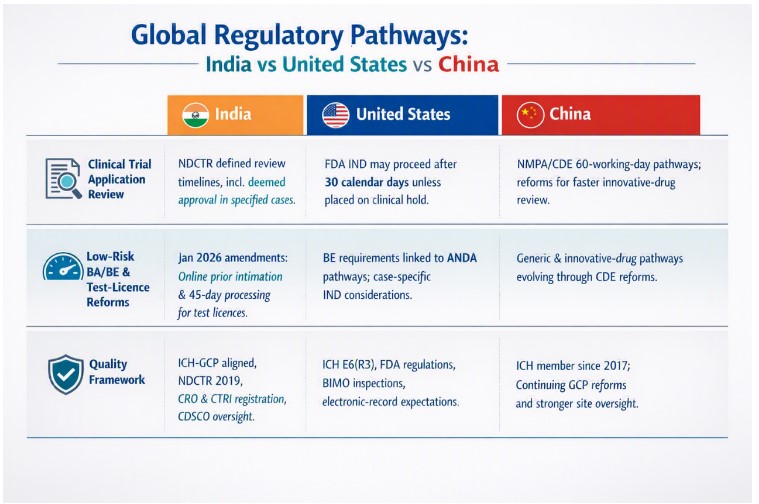
China offers an important reference point. Its clinical research rise was not built on cost alone. It was built through coordinated government investment, a faster regulatory environment, hospital participation, investigator development, and a deliberate push into innovation-led drug development. India now has a similar opportunity, but we must execute with discipline. We are no longer only a generic-drug development country. Indian companies are moving into biologics, biosimilars, oncology, complex generics, vaccines, and novel therapeutics. That transition requires a CRO ecosystem that can support preclinical work, Phase I and Phase II studies, complex patient trials, real-world evidence, and global regulatory expectations.

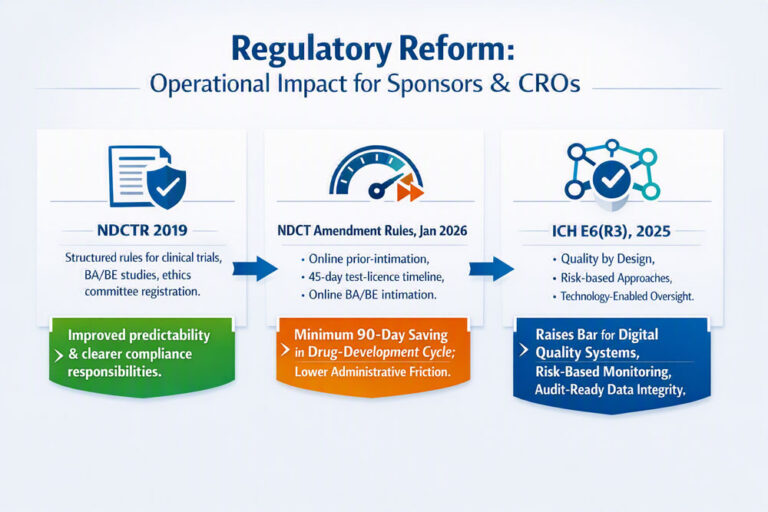
Regulatory reform is helping. The New Drugs and Clinical Trials Rules, 2019 created a more structured framework for clinical trials, ethics committees, BA/BE studies, and investigational products. The January 2026 amendments replaced certain test-licence requirements with an online prior-intimation mechanism, reduced statutory processing timelines for applicable test licences from 90 days to 45 days, and allowed specified low-risk BA/BE studies to proceed through online intimation. The Government stated that these changes are expected to save at least 90 days in the drug-development life cycle and reduce CDSCO’s administrative load across roughly 30,000 to 35,000 test-licence applications annually.

At Veeda, our response is to build for intelligence and speed. Our platform spans preclinical research, early-phase studies, Phase I to IV clinical trials, bioanalysis, and oncology-focused global trial delivery. The Mango Sciences partnership adds a patient-intelligence layer to that operating model. Its AI-powered Querent platform supports oncology patient identification, trial design, and monitoring by converting fragmented clinical records into usable evidence. That is the direction Indian CROs must take. Competing on price alone keeps us replaceable. Competing on scientific capability, technology, and predictable execution makes India strategic.

Q. What makes India's clinical data ecosystem uniquely valuable for global sponsors, particularly in terms of patient diversity and real-world evidence?

India’s clinical data ecosystem is valuable because it combines disease burden, population diversity, and increasing digital health infrastructure. But I want to be very direct. Diversity alone will not make India globally competitive. Sponsors are looking for speed and quality. Both depend on technology, not just population size.

India’s genetic, ethnic, dietary, socioeconomic, and geographic diversity can help global sponsors design trials that better reflect real-world patient populations. This matters more after FDORA, under which the US FDA has issued guidance on Diversity Action Plans for clinical studies. The requirement applies to certain late-stage studies after final implementation timelines, and sponsors must define enrolment goals and explain how they will reach relevant populations. India can support that agenda, especially in oncology, metabolic disease, infectious disease, and other high-burden areas.

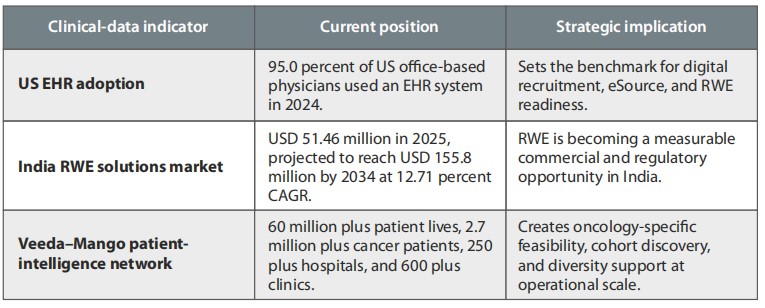
The constraint is digital maturity. US office-based physician EHR adoption reached 95.0 percent in the 2024 National Electronic Health Records Survey, while India’s functional EMR adoption remains far lower and uneven across institutions. The Ayushman Bharat Digital Mission is a positive structural step because it creates the identity and interoperability foundation for longitudinal health records, but India still needs deep clinical EMR implementation at trial-active hospitals. Without that, AI-led recruitment, eSource, remote monitoring, and real-world evidence will remain limited to islands of excellence.

Q. What does an AI-driven clinical trial look like in practice, and where is it creating the greatest impact today?

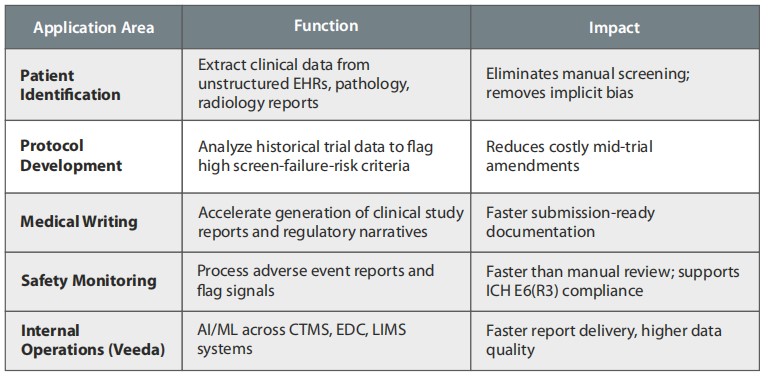
An AI-driven clinical trial is a trial where data intelligence is embedded before the first patient is enrolled. It begins with protocol feasibility, not site activation. AI models can test whether inclusion and exclusion criteria are too restrictive, identify likely screen-failure drivers, and estimate the depth of eligible patient pools before operational commitments are made.
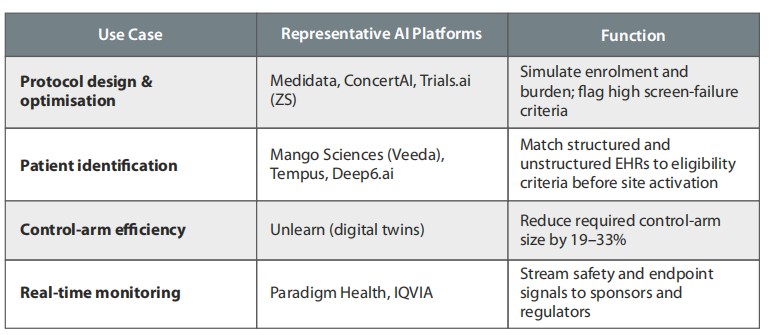
The biggest current use cases are patient identification, protocol design, and risk-based monitoring. Globally, oncology-data and AI-enabled clinical-research platforms such as Flatiron Health, Tempus, ConcertAI, Paradigm, IQVIA, and technology-enabled CRO models show where the market is moving. The common theme is simple. Trial execution is becoming data-led rather than site-memory-led.

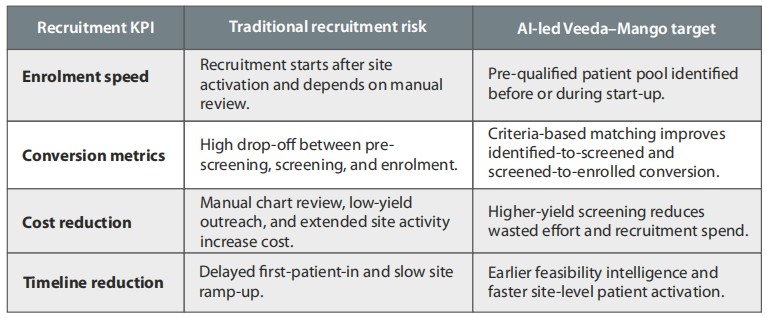
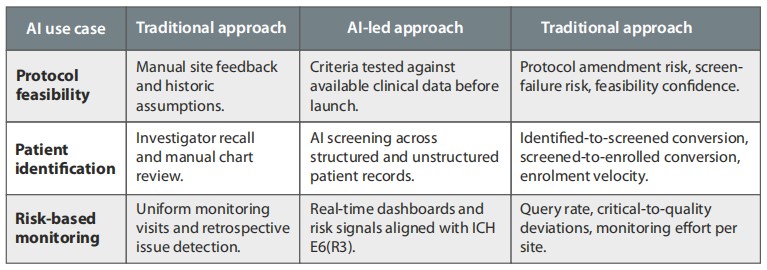
At Veeda, the Mango Sciences partnership makes this practical in oncology and early-stage development. The Querent platform uses AI, LLMs, and generative AI workflows to read structured and unstructured records, including physician notes, radiology reports, pathology reports, and discharge summaries. It then maps clinical variables to trial criteria and helps identify likely eligible patients. For sponsors, the KPIs that matter are enrolment speed, conversion from identified patients to screened patients, conversion from screened to enrolled patients, and reduction in cost and timelines compared with traditional site-led recruitment. Those are the metrics we track because those are the metrics that change development economics. 
Q. How are AI platforms transforming fragmented and unstructured clinical data into actionable, trial-grade intelligence?

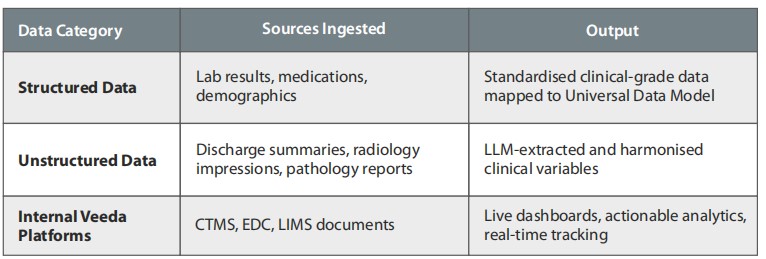
The core problem in clinical data is not volume. It is usability. Most clinically important information is not sitting neatly in structured fields. It sits in physician notes, radiology impressions, pathology reports, discharge summaries, medication narratives, and scanned documents. In oncology, this is especially important because eligibility often depends on staging, biomarkers, prior lines of therapy, imaging findings, performance status, progression history, and laboratory thresholds.

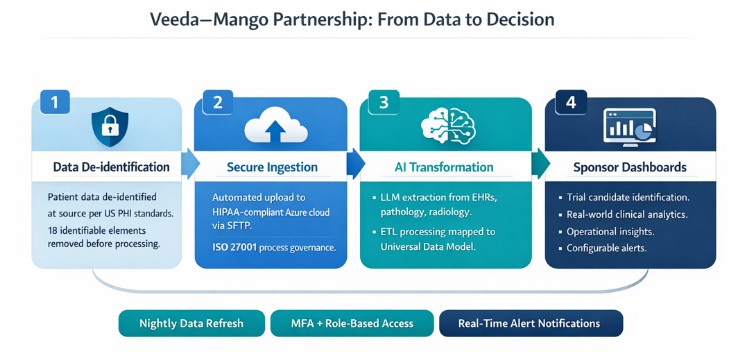
AI platforms transform this fragmented data through a disciplined sequence. They ingest data from hospital systems, extract clinical variables from unstructured text, standardise terminology, de-identify records where required, and map the output to a universal data model. LLMs are useful because they can interpret clinical language, not merely search keywords. The practical value is that a patient described differently across a radiology report, a treating physician note, and a pathology report can still be represented consistently for trial matching.

At Veeda, Mango Sciences provides this external patient-intelligence layer while our internal CTMS, EDC, LIMS, and operational systems support trial execution, quality oversight, and reporting. That combination matters. AI recruitment without clinical operations cannot deliver a trial. Clinical operations without patient intelligence cannot deliver speed in complex indications. The future belongs to platforms that combine both.

Q. How are Large Language Models and Generative AI improving efficiency, decision making, or outcomes in clinical research workflows?

Large Language Models and Generative AI are solving a specific category of problems in clinical research: tasks that require interpreting unstructured text, synthesising complex information across documents, and generating standardised outputs from variable inputs. These tasks consume enormous human hours and introduce inconsistency. LLMs address them at speed and scale.

The most immediate application at Veeda is information extraction from clinical records. Through the Mango Sciences platform, LLMs unlock critical clinical data “trapped” in unstructured sources – clinical notes, radiology impressions, discharge summaries, pathology reports. The LLM transforms these into standardised, clinical-grade data that feeds directly into patient identification workflows and cohort building. Without this capability, a clinical research associate would manually review each patient record – a process that is slow, expensive, and prone to human error and implicit bias. LLM-based extraction removes that bottleneck entirely.

The practical standard we apply is simple: every AI deployment must deliver measurable improvement in speed, quality, or cost – preferably all three. We are disciplined about where we deploy them, and we measure outcomes rigorously. That discipline is what separates operational AI from experimental AI.

Q. How does an AI-led approach change patient recruitment strategies and reduce delays in clinical trials?

AI-led recruitment changes the starting point of a trial. Traditional recruitment begins after site activation. AI-led recruitment begins before site activation, by asking a sharper question. Where are the eligible patients likely to be, how many are realistically recruitable, and which eligibility criteria are limiting conversion?

In a traditional model, investigators manually review charts or rely on memory of patient panels. That creates delays, selection bias, and inconsistent screening. In the AI-led model, structured and unstructured records are reviewed systematically against trial eligibility criteria. The site receives a pre-qualified patient pipeline instead of starting from a blank slate.

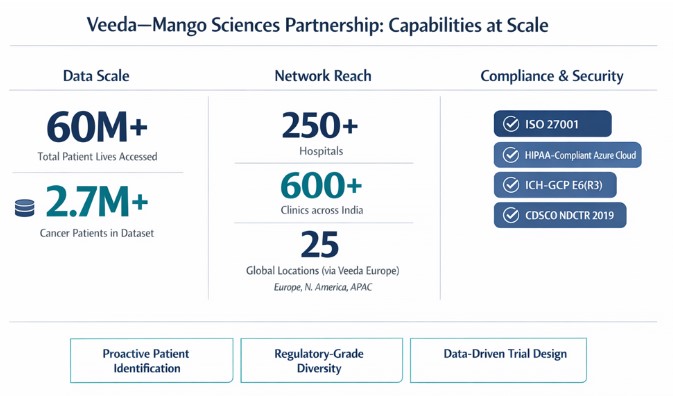
For Veeda, this is especially relevant in oncology and Phase I/II early-stage trials, where the right patient profile can be narrow and the cost of delay is high. Mango Sciences gives us access to an AI-powered database covering 60 million plus patient lives, including 2.7 million plus cancer patients across 250 plus hospitals and 600 plus clinics. We treat four KPIs with equal importance: enrolment speed, conversion metrics, cost reduction, and timeline reduction versus traditional methods. A recruitment engine that only finds more names is not enough. It must convert identified patients into enrolled patients faster, with fewer screen failures and better representativeness.

Q. What kinds of data integration, interoperability, and infrastructure capabilities are essential for India to compete globally in clinical research?

India’s next competitive advantage will depend on data infrastructure. We generate large volumes of clinical information, but too much of it remains locked in hospital systems, diagnostic centres, paper records, non-interoperable EMRs, and local workflows. Global sponsors cannot use data that cannot be standardized, governed, and audited.

Three capabilities are essential. First, data standardization, so clinical concepts mean the same thing across institutions. Second, interoperability, so trial systems, hospital systems, labs, imaging centres, and patient-facing tools can exchange usable data. Third, regulatory-grade governance, including consent, de-identification, access controls, audit trails, and traceability.

ABDM is important because it creates national rails for digital health identity and data exchange. But clinical research requires an additional layer. Trial-active hospitals need functional EMRs, trained investigators, compatible eSource and EDC workflows, and systems capable of supporting remote monitoring and RWE generation. India does not have to copy the US model, but it must close the digital gap quickly. If we do not, our population advantage will remain underutilized.

Q. How are digital clinical platforms being designed to meet evolving global expectations around compliance, data integrity, and regulatory oversight?

Digital clinical platforms are now being designed around risk-based quality management, not only data capture. ICH E6(R3), adopted by ICH in January 2025 and issued as final FDA guidance in September 2025, explicitly supports flexible, risk-based approaches, quality by design, modern data sources, and technology-enabled oversight. That is a major shift in how sponsors and CROs must think about compliance.

At Veeda, the design principle is simple. Data integrity must be built into the architecture. CTMS, EDC, LIMS, eConsent, remote monitoring, and patient-intelligence systems must enforce role-based access, time-stamped audit trails, version control, query tracking, and exception management. Compliance cannot depend on people remembering to document after the fact.

Risk-based monitoring is also becoming more precise. Instead of treating every site as equally risky, digital platform can flag deviations in critical-to-quality factors, late data entry, protocol deviations, missing safety data, or unusual query patterns. This allows monitors to focus effort where risk is highest. For multi-region studies, that is essential. It improves quality, reduces unnecessary monitoring burden, and creates a stronger inspection record.

Q. How has India's evolving regulatory framework strengthened its competitiveness in global clinical research?

India’s regulatory framework has become more predictable, and predictability is one of the most important factors in global trial placement. Sponsors can manage cost variation. They can manage operational complexity. What they cannot manage is regulatory uncertainty.

NDCTR 2019 created the foundation by codifying timelines, ethics committee requirements, clinical trial approvals, BA/BE studies, compensation rules, and investigational-product oversight. The 2024 CRO registration amendment added a formal accountability layer for CROs. The January 2026 amendments then reduced procedural friction for specified low-risk activities through online prior intimation, a 45-day timeline for applicable test licenses, and online intimation for specified low-risk BA/BE studies.

The direction is clear. India is moving from permission-heavy regulation to a more risk-based, trust-based, digitally supported framework. That helps CROs and sponsors only if the industry responds with stronger quality systems. Faster pathways increase responsibility. They do not reduce it. For Veeda, this is why we invest in audit-ready systems, trained investigators, digital oversight, and platforms that support global standards across jurisdictions.

Q. What role do digital platforms and automation play in enabling seamless regulatory compliance and submissions for CROs and sponsors?

Digital platforms and automation turn compliance from an after-the-event documentation exercise into a live operating system. This is essential because a single global study may need to satisfy CDSCO, US FDA, EMA, and local ethics requirements at the same time.

The next major step is EMR-to-EDC conversion. If source data can move securely and traceably from clinical systems into trial databases, CROs can reduce transcription errors, accelerate query resolution, improve safety reporting, and support remote source-data review. This does not remove the need for oversight. It makes oversight more continuous and more evidence based.

For India, automation is also relevant because CDSCO is moving toward more digital workflows. The January 2026 NDCT amendments introduced online intimation mechanisms. CROs that can connect internal document management, EDC, safety systems, audit trails, and regulatory submission workflows will move faster with fewer compliance gaps. In practical terms, the submission becomes a by-product of disciplined trial execution rather than a separate scramble at the end.

Q. How does the Veeda–Mango collaboration reflect a new model of CRO partnerships combining clinical expertise with AI and data intelligence?

The Veeda–Mango collaboration reflects a broader global shift. Clinical research partnerships are no longer only about operational capacity. They are about combining clinical execution with proprietary data intelligence. Globally, oncology-data and AI-enabled models such as Flatiron Health, Tempus, ConcertAI, Paradigm, IQVIA’s real-world data capabilities, and recent technology-led CRO investments point to the same conclusion. Patient intelligence is becoming central to trial competitiveness.

For Veeda, Mango Sciences is strategically important because it gives us an AI-powered oncology patient-identification capability that complements our clinical operations. The platform covers 60 million plus patient lives, including 2.7 million plus cancer patients, across 250 plus hospitals and 600 plus clinics. It is designed to transform unstructured clinical data into trial-grade intelligence using LLMs, generative AI, and universal data models.

The commercial logic is clear. Sponsors want faster enrolment, better conversion, lower recruitment waste, shorter timelines, and more representative cohorts. The Veeda–Mango model addresses all four. It supports oncology and Phase I/II early-stage development where eligibility is complex, the patient pool is narrow, and every month of delay is costly. Other client examples should remain anonymized, but the insight is consistent across complex studies. The CRO that can combine clinical depth with data intelligence becomes a development partner, not a vendor.

Q. What will define India's success as a global CRO innovation hub over the next three to five years?

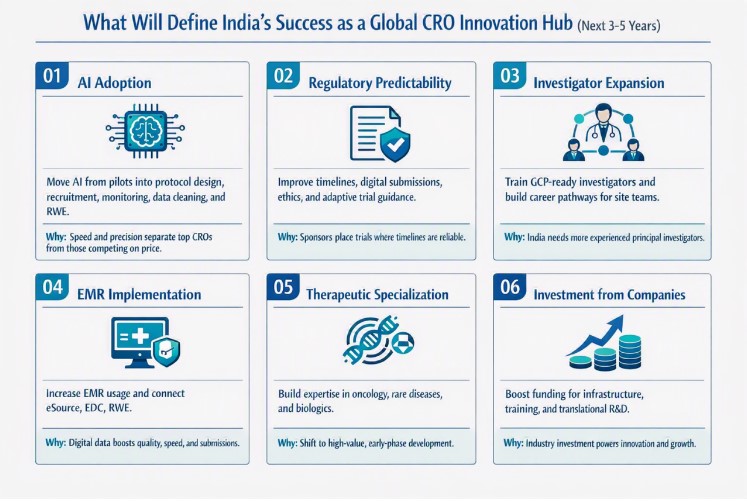
India’s success over the next three to five years will depend on execution across five linked priorities.

At Veeda, our ambition is to be recognized by 2028 as the preferred development partner for complex, multi-region studies. India has the patient base, regulatory momentum, scientific talent, and cost efficiency. The next phase is about building the digital, investigator, and quality infrastructure that converts those assets into globally competitive execution.