

What a 483 actually says, what it costs, and how to read one the way an operator reads it – not the way a headline does.
By Dr. Ravi Sanivarapu
Every senior leader evaluating an Indian pharmaceutical company – whether as an investor, a board member, or a strategic partner – eventually encounters the same three letters: a Form 483. Most treat it the way the press treats it. A headline. A red flag. A reason for concern, vaguely defined. Almost none of them read it the way I do – as a structured technical document that, properly analysed, predicts financial outcomes with real precision. This article is for the senior leaders who want to move past the headline.
At the close of a USFDA inspection, the investigator issues a Form 483 if they have observed conditions that may violate the Food, Drug, and Cosmetic Act. It is a list – sometimes one item, sometimes twenty – of specific observations.
It is not a penalty. It is not an enforcement action. It carries no immediate legal consequence. It is, however, the single most informative document most outside observers never read properly.
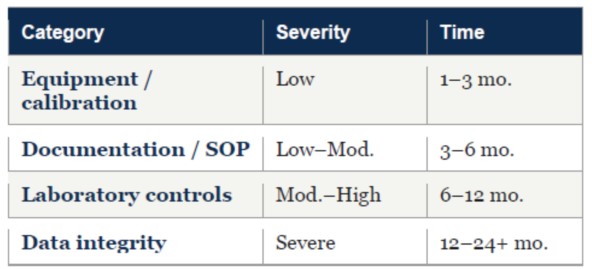
A 483 with one observation about a minor calibration lapse and a 483 with one observation about data integrity are treated by the market as equally serious. They are not. The category is everything
The USFDA conducted 212 drug-facility inspections in India in 2025, down from 284 the year before – yet India still accounts for roughly 18% of all FDA inspections globally, despite representing a much smaller share of global manufacturing sites. For context, India’s share of global FDA inspections was just 6% in 2014. The scrutiny has intensified faster than the industry narrative usually acknowledges.
Observations broadly fall into a hierarchy of severity. Equipment and calibration issues are typically the least severe – correctable with process discipline. Laboratory control failures sit in the middle. Data integrity observations sit at the top – they question whether the company’s underlying records can be trusted at all, which has implications far beyond the specific finding.

A 2024 FDA inspection of an Indian drug manufacturer in Himachal Pradesh produced a 17-page Form 483 with 10 observations – including a malfunctioning UV spectrophotometer that had been retired without any investigation into the test results it had already generated, several of which had been released into the US market. A separate 2024 inspection of an API and finished-dose facility in Hyderabad produced a 26-page Form 483 with 24 distinct deficiencies spanning facilities, equipment, production, and data integrity. Both examples illustrate the same point: the page count and category mix of a 483 tell you more than its mere existence.
A single observation is information. Twelve observations across six different functional areas is a different signal entirely – it suggests the quality management system itself, not an isolated process, is the underlying issue.
The gap between best and worst performers in the same company can be striking. One major Indian manufacturer’s injectable facility completed a 2024 inspection with zero observations – described in industry commentary as “a gold standard” outcome. The same company’s facility in Goa received seven observations in a separate 2025 inspection. Site-level quality culture, not corporate scale, is usually the deciding factor.
This is the factor most outside observers miss entirely. A first-time observation in a category is a finding. The same category appearing in two or three consecutive inspection cycles means the previous corrective action did not address the root cause. This is the single strongest predictor I use for forecasting whether a 483 will escalate to a Warning Letter.
A peer-reviewed analysis of USFDA 483s and Warning Letters issued to Indian pharmaceutical companies between 2023 and November 2024 found that a Form 483 carries more than a 50% probability of escalating to a Warning Letter – materially higher when the company’s response is inadequate. Of 20 pharmaceutical firms that received Warning Letters in that period, 10 had already been issued Form 483 observations in earlier inspections. The remainder received Warning Letters on their first inspection, typically reflecting serious GMP violations rather than a missed second chance.
Companies have 15 working days to respond to a 483. A strong response identifies the systemic root cause and commits to verifiable, time-bound corrective actions. A weak response restates existing procedures and calls it corrective action. I have read enough of both to recognise the difference within the first two paragraphs.
When I review a Form 483 as part of a technical assessment, I follow a consistent sequence. I categorise every observation by severity. I check whether any category has appeared in the company’s two prior inspection cycles. I read the company’s response letter in full – not the summary – and assess whether it addresses root cause or merely restates procedure. And I estimate the realistic remediation timeline based on category and company track record, not on what management projects.
That sequence, repeated consistently, is what allows a 483 to be translated from a regulatory document into a financial forecast.
It is worth noting what the data shows is working. Companies that have invested in digital Quality Management Systems – replacing paper logbooks with validated electronic batch records and laboratory systems – have shown measurably better inspection outcomes. One major manufacturer reduced its Form 483 count from 7 in FY23 to 2 in FY24, with total observations falling from 55 to just 3 in the same period, a change the company attributes substantially to digital QMS adoption. The USFDA’s own data shows “documentation discipline” findings account for roughly 21% of all observations industry-wide – precisely the category digital systems are best positioned to address.

The progression from observation to enforcement is not abstract. It follows a documented pattern, and recent data makes the path easier to quantify than it was even three years ago.
In calendar year 2025, Official Action Indicated (OAI) classifications for Indian drug facilities fell to roughly 7%, down from 13% in 2023 – a genuine improvement. But the combined count of import alerts and Warning Letters issued to Indian sites has stayed remarkably stable: 25 in 2023, 21 in 2024, and 23 in the first eleven months of 2025, according to ratings agency ICRA. Fewer OAI classifications have not yet translated into proportionally fewer enforcement actions – which tells a senior leader that existing compliance gaps are still working their way through the system even as new ones decline.
An OAI classification is the formal bridge between a serious 483 and a Warning Letter or import alert. One large Indian manufacturer’s Gujarat facility was classified OAI in 2025 following a mid-year inspection and remains under an import alert today, blocking most shipments to the US market. These are not edge cases – they are illustrative of how quickly a single facility’s classification can move from observation to market access restriction.
This is where most analysis stops short. A 483 is reported as a compliance event. It should be reported as a financial event, because that is what it becomes.
A 483 with credible, well-executed remediation typically resolves within one inspection cycle, at a direct cost in the range of supplemental staffing, consultancy support, and management time – material but contained.
A 483 with a repeat observation category, or a weak initial response, frequently escalates. The progression from 483 to Warning Letter to import alert is not automatic, but it follows a recognisable pattern – and at each stage, the financial exposure compounds. Revenue from regulated markets can be suspended. Remediation timelines extend from months to years. Management attention shifts entirely toward regulatory recovery, away from growth.
Following 483 issuances with significant findings, more than one major Indian manufacturer has halted manufacturing immediately after the inspection concluded – in one widely reported 2022 case, the resulting production pause at a large oncology drug facility contributed directly to a documented shortage of a critical cancer therapy in the US market. The financial cost of a 483 is rarely confined to the company that received it.
For a senior leader assessing a company’s risk profile, the question is never simply “does this company have a 483 outstanding.” The question is which category, what pattern, and what quality of response.
Indian pharmaceutical manufacturing will remain central to global drug supply for the foreseeable future. India still accounts for an estimated 40-45% of generic drug volume sold in the US market – a position that intensified regulatory scrutiny has not meaningfully eroded, but one that makes every individual compliance failure more consequential to global supply chains than it would be in a smaller market.
The companies that build sustainable compliance – not performed compliance – will be the ones that command premium valuations, attract long-term capital, and avoid the costly disruptions that erode shareholder value.
Understanding what a Form 483 actually says – not what the headline implies – is one of the most practical skills a senior leader evaluating this sector can develop.
It costs nothing to learn. It can save a great deal to apply.
Dr. Ravi Sanivarapu is the Founder of RPR Pharma Consulting, a specialist technical due diligence advisory for PE, VC, and strategic investors in global pharmaceutical companies. He brings over 30 years of senior leadership experience across manufacturing operations, quality, regulatory affairs, and compliance.