

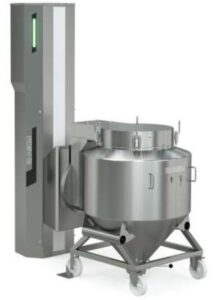
 With the PM 1000 bin blender, L.B. Bohle is presenting a technically optimized version of one of the company’s best-selling systems in a new design. “Our PM blenders, featuring the blending element integrated into the bin lid and successfully developed and patented by Lorenz Bohle, were the first catalyst for the company’s growth,” recalls Wesselmann. From the very beginning, these blenders have used an electromechanical drive and continue to stand out not only for their versatility and durability, but above all for their efficiency.
The systems can be used in pharmaceutical manufacturing across a wide scale range, depending on the process, from 14 to 12,000 liters. As standard, blending bins up to 2,400 liters are designed as exchangeable bins. Effective blending can be achieved at fill levels between 20 and 85 percent and with bulk densities from 0.2 to 1.2 kg/dm³.
 “With the new PM, the updated appearance is immediately noticeable,” says Wesselmann. The entire electrical system is integrated into the machine itself, resulting in a smaller footprint and eliminating the need for an external control cabinet. “Particularly striking are the signal lights on the left and right sides of the lifting column, which indicate the machine status to the operator,” he adds.
The design team has also modified the rotary drive, making it more maintenance-friendly. Lubrication is now based on operating hours rather than performed automatically. In addition, the lifting drive is now equipped with a frequency converter as standard, providing greater process control, enhanced safety, and reduced wear.
The blending motor complies with IE4 energy-efficiency class. Compared with IE3 motors, IE4 motors reduce energy losses by approximately 15 percent, lowering operating costs while improving the machine’s overall energy performance.
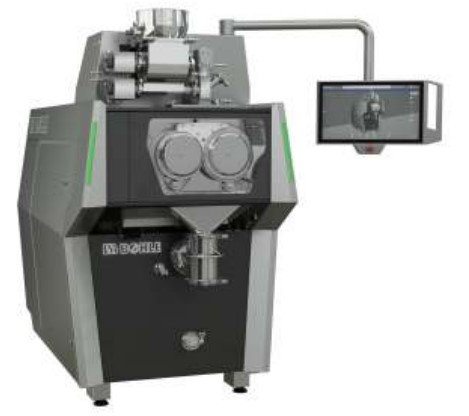
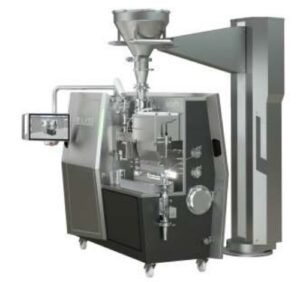 At interpack, L.B. Bohle will also present QbCon® 1, its solution for continuous wet granulation and drying. “Whether in research and development or in pilot and small-batch production, QbCon® 1 offers our customers numerous practical advantages,” says Schmidt.
Valid process results can be generated within minutes. “Tests with very small material quantities starting at just 50 grams are also possible, which is particularly important in R&D,” he adds.
QbCon® 1 ensures process control to maintain quality at all times. Through the in-line use of Process Analytical Technology (PAT), product quality can be monitored continuously throughout the process. Deviations are detected immediately and can be corrected at once. As a result, entire batches do not have to be discarded in the event of an error, less out-of-specification (OOS) material must be rejected, and product variability is reduced.
Real-time analysis of both process and product also opens the door to real-time release testing for pharmaceuticals. This creates the opportunity to establish 100 percent non-destructive inspection of all manufactured products.
 L.B. Bohle will also present the BTM hammer mill, a compact and versatile solution for research, development, batch production, and continuous manufacturing.
Operating at speeds from 600 to 6,000 rpm, the BTM achieves throughput rates of up to 1,500 kg/h. An automatic feeding device ensures uniform feeding into the milling chamber, prevents overfilling, and reduces heat generation. Different screen inserts enable particle sizes down to below 100 µm. Thanks to a rotor with both impact and knife sides, the system can process hard, crystalline, as well as sticky products.
L.B. Bohle will also show the technically optimized BTS 200. The BTS is used for particle-size calibration of dry or wet products and enables sieving, lump breaking and control screening. Greater operator convenience, optimized CIP cleaning, and reduced product loss through improved paddle geometry distinguish this new flexible system.